O Levels/IGCSE Chemistry (5070)•5070/12/M/J/22
O Levels/IGCSE Chemistry (5070) — 5070/12/M/J/22, Question 23
What is an observation of an oxidation process?
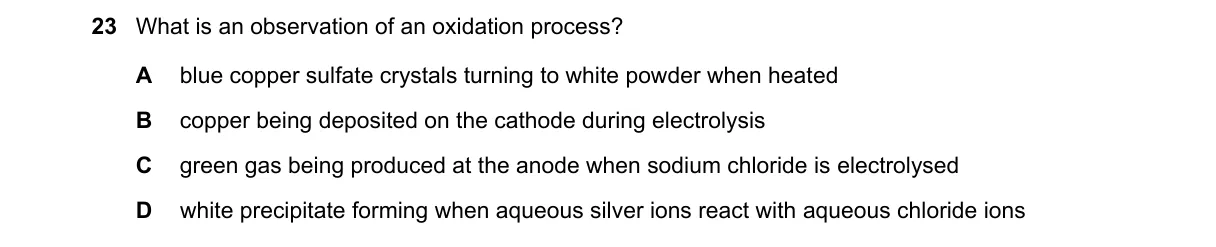
Answer choices
- Ablue copper sulfate crystals turning to white powder when heated
- Bcopper being deposited at the cathode during electrolysis
- Cgreen gas being produced at the anode when sodium chloride is electrolysed
- Dwhite precipitate forming when aqueous silver ions react with aqueous chloride ions
Explanation
Oxidation as loss of electrons at the anode
Steps:
- Define oxidation as the loss of electrons from a species.
- In electrolysis, oxidation occurs at the anode where anions lose electrons.
- Examine options for electron loss producing a visible change.
- Select the option matching anodic oxidation with a color observation.
Why C is correct:
- In NaCl electrolysis, Cl⁻ ions oxidize at the anode (2Cl⁻ → Cl₂ + 2e⁻), producing green chlorine gas, directly observing electron loss.
Why the others are wrong:
- A: Heating CuSO₄·5H₂O to anhydrous CuSO₄ is dehydration, not electron loss.
- B: Cu²⁺ gaining electrons at the cathode (Cu²⁺ + 2e⁻ → Cu) is reduction, not oxidation.
- D: Ag⁺ + Cl⁻ → AgCl is precipitation via ion combination, not electron transfer.
Final answer: C
Topic: Redox
Practice more O Levels/IGCSE Chemistry (5070) questions on mMCQ.me