O Levels/IGCSE Chemistry (5070)•5070/12/M/J/22
O Levels/IGCSE Chemistry (5070) — 5070/12/M/J/22, Question 19
What is the balanced equation and enthalpy change, ΔH, for the complete combustion of butanol, C4H9OH?
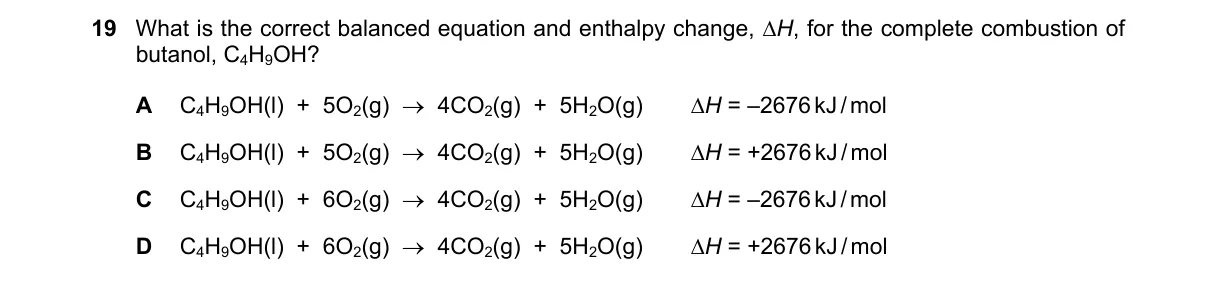
Answer choices
- AC4H9OH(l) + 6O2(g) → 4CO2(g) + 5H2O(g) ΔH = -2676 kJ/mol
- BC4H9OH(l) + 6½O2(g) → 4CO2(g) + 5H2O(g) ΔH = -2676 kJ/mol
- CC4H9OH(l) + 6½O2(g) → 4CO2(g) + 5H2O(g) ΔH = -2676 kJ/mol
- DC4H9OH(l) + 6O2(g) → 4CO2(g) + 5H2O(g) ΔH = -2676 kJ/mol
Explanation
Proper balancing of the combustion equation for butanol Steps:
- Identify atoms in C4H9OH: 4 C, 10 H (from C4H9OH), 1 O.
- Balance carbon atoms: requires 4 CO2 on product side.
- Balance hydrogen atoms: requires 5 H2O on product side (10 H total).
- Balance oxygen atoms: products need 13 O (8 from CO2 + 5 from H2O); 1 O from butanol leaves 12 O needed from O2, so 6 O2.
Why A and D are correct:
- They use 6 O2, conserving atoms per the law of conservation of mass in balanced equations.
Why the others are wrong:
- B: Uses 6½ O2, providing 13 O atoms from oxygen (plus 1 from fuel = 14 total), mismatching 13 O in products.
- C: Uses 6½ O2, providing 13 O atoms from oxygen (plus 1 from fuel = 14 total), mismatching 13 O in products.
Final answer: A and D
Topic: Alcohols
Practice more O Levels/IGCSE Chemistry (5070) questions on mMCQ.me