O Levels/IGCSE Chemistry (5070)•5070/12/M/J/22
O Levels/IGCSE Chemistry (5070) — 5070/12/M/J/22, Question 17
Aluminium can be extracted by the electrolysis of aluminium oxide dissolved in molten cryolite. Which reactions take place during the electrolysis?
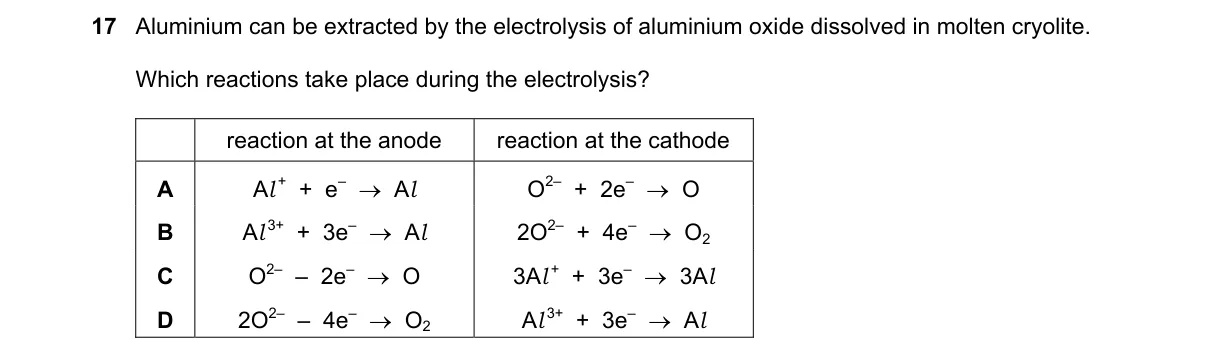
Answer choices
- Aanode: Al³⁺ + 3e⁻ → Al, cathode: O²⁻ + 4e⁻ → O₂
- Banode: O²⁻ + 4e⁻ → O₂, cathode: Al³⁺ + 3e⁻ → Al
- Canode: O²⁻ + 4e⁻ → O₂, cathode: Al³⁺ + 3e⁻ → Al
- Danode: O²⁻ + 4e⁻ → O₂, cathode: Al³⁺ + 3e⁻ → Al
Explanation
Electrode reactions in aluminum electrolysis Steps:
- Cathode is site of reduction: Al³⁺ ions from the melt gain 3 electrons to deposit Al metal.
- Anode is site of oxidation: O²⁻ ions from the melt lose 4 electrons to form O₂ gas (balanced as 2O²⁻ → O₂ + 4e⁻).
- Eliminate options with reversed or mismatched half-reactions.
- Select option assigning Al reduction to cathode and O oxidation to anode.
Why D is correct:
- Matches electrolysis rules: reduction (Al³⁺ + 3e⁻ → Al) at cathode deposits metal; oxidation (O²⁻ to O₂) at anode releases oxygen, per electrode definitions.
Why the others are wrong:
- A: Reverses electrodes—reduction cannot occur at anode.
- B: Shows anode reaction as reduction (electrons gained), contradicting oxidation requirement.
- C: Uses unbalanced equation for anode (single O²⁻ cannot yield O₂ without 2O²⁻).
Final answer: D
Topic: Electrolysis
Practice more O Levels/IGCSE Chemistry (5070) questions on mMCQ.me