O Levels/IGCSE Chemistry (5070)•5070/12/M/J/22
O Levels/IGCSE Chemistry (5070) — 5070/12/M/J/22, Question 12
Aqueous silver nitrate, AgNO₃, reacts with aqueous potassium chromate(VI), K₂CrO₄, to give a yellow precipitate.
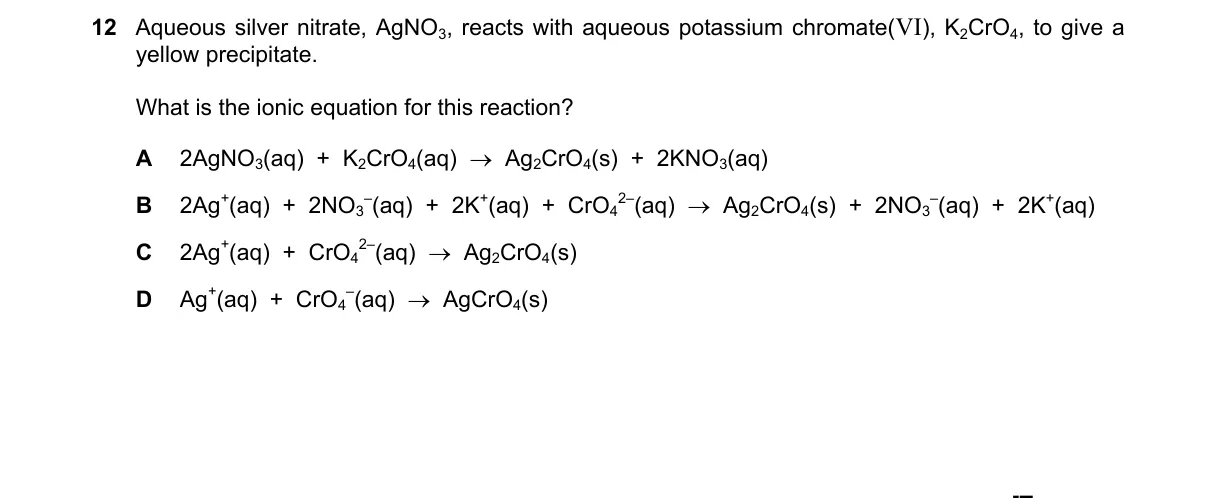
Answer choices
- A2AgNO₃(aq) + K₂CrO₄(aq) → Ag₂CrO₄(s) + 2KNO₃(aq)
- B2Ag⁺(aq) + 2NO₃⁻(aq) + 2K⁺(aq) + CrO₄²⁻(aq) → Ag₂CrO₄(s) + 2NO₃⁻(aq) + 2K⁺(aq)
- C2Ag⁺(aq) + CrO₄²⁻(aq) → Ag₂CrO₄(s)
- DAg⁺(aq) + CrO₄²⁻(aq) → AgCrO₄(s)
Explanation
Net Ionic Equation for Precipitation
Steps:
- Write the molecular equation: 2AgNO₃(aq) + K₂CrO₄(aq) → Ag₂CrO₄(s) + 2KNO₃(aq).
- Dissociate into total ionic: 2Ag⁺(aq) + 2NO₃⁻(aq) + 2K⁺(aq) + CrO₄²⁻(aq) → Ag₂CrO₄(s) + 2K⁺(aq) + 2NO₃⁻(aq).
- Cancel spectator ions (K⁺ and NO₃⁻) that appear unchanged on both sides.
- Result: 2Ag⁺(aq) + CrO₄²⁻(aq) → Ag₂CrO₄(s), matching option C.
Why C is correct:
- It is the net ionic equation, showing only reacting species per solubility rules for precipitates.
Why the others are wrong:
- A includes spectator ions and is the full molecular equation.
- B is the total ionic equation without canceling spectators.
- D has incorrect 1:1 stoichiometry and formula (Ag₂CrO₄ requires 2:1 ratio).
Final answer: C
Topic: Identification of ions and gases
Practice more O Levels/IGCSE Chemistry (5070) questions on mMCQ.me