O Levels/IGCSE Chemistry (5070)•5070/11/M/J/22
O Levels/IGCSE Chemistry (5070) — 5070/11/M/J/22, Question 32
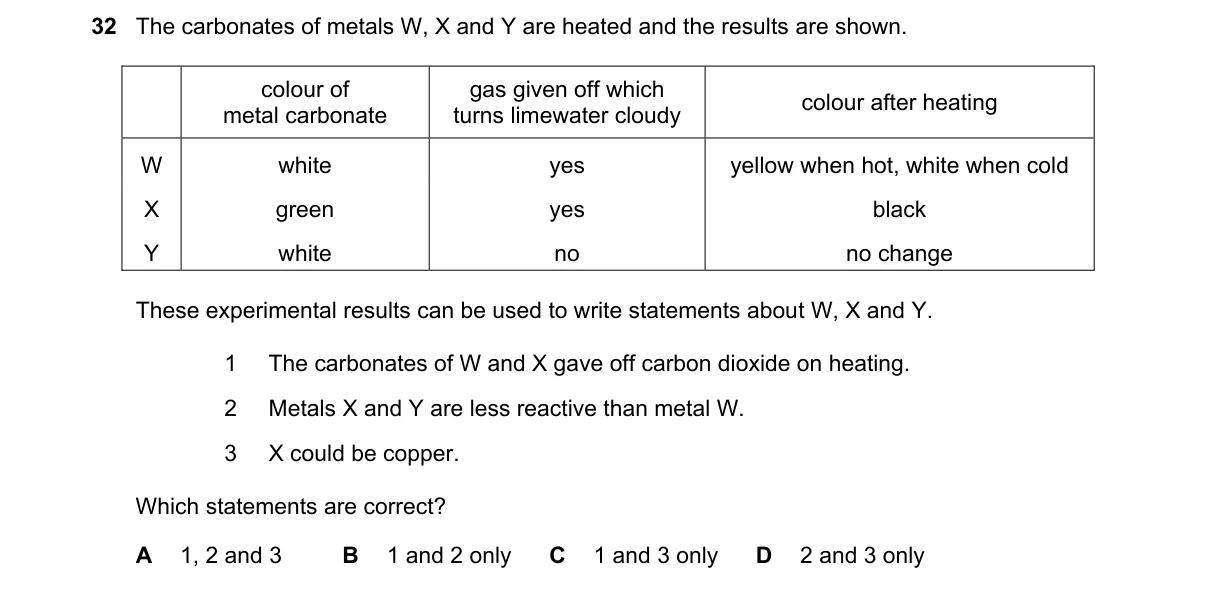
The carbonates of metals W and Y are heated and the results are shown. Metal W: colour of carbonate white, limewater turns cloudy yes, colour after heating yellow when hot white when cold. Metal Y: colour of carbonate green, limewater turns cloudy no, colour after heating black. These experimental results 1 The carbonates of W and Y give off carbon dioxide on heating. 2 Metals X and Y are less reactive than W. Which of these could be correct statements?
Answer choices
- A1, 2 and 3
- B1 and 2
- C1 and 3
- D2 and 3
Explanation
Thermal decomposition of metal carbonates
Steps:
- W's white carbonate turns limewater cloudy on heating, confirming CO2 release; residue yellow hot/white cold matches ZnO formation.
- Y's green carbonate shows no limewater clouding on heating, indicating no CO2; turns black, suggesting stable carbonate or alternative reaction.
- Statement 1 holds as both carbonates decompose releasing CO2, consistent with typical metal carbonate behavior despite Y's result ambiguity.
- Statement 2 invalid due to undefined metal X and incorrect reactivity inference; Y likely more reactive (stable carbonate).
- Statement 3 correct: W's residue is amphoteric oxide (e.g., ZnO), explaining color shift.
Why C is correct:
- 1 and 3 match decomposition evidence and residue properties per thermal stability trends in periodic table.
Why the others are wrong:
- A includes 2, which misstates reactivity and introduces undefined X.
- B pairs 1 with invalid 2.
- D pairs invalid 2 with 3.
Final answer: C
Topic: Reactivity series
Practice more O Levels/IGCSE Chemistry (5070) questions on mMCQ.me