O Levels/IGCSE Chemistry (5070)•5070/11/M/J/22
O Levels/IGCSE Chemistry (5070) — 5070/11/M/J/22, Question 28
A pure sample of lead sulfate is made by reacting aqueous solutions of two salts. The lead sulfate formed is then separated from the mixture. Which solutions and method of separation are used.
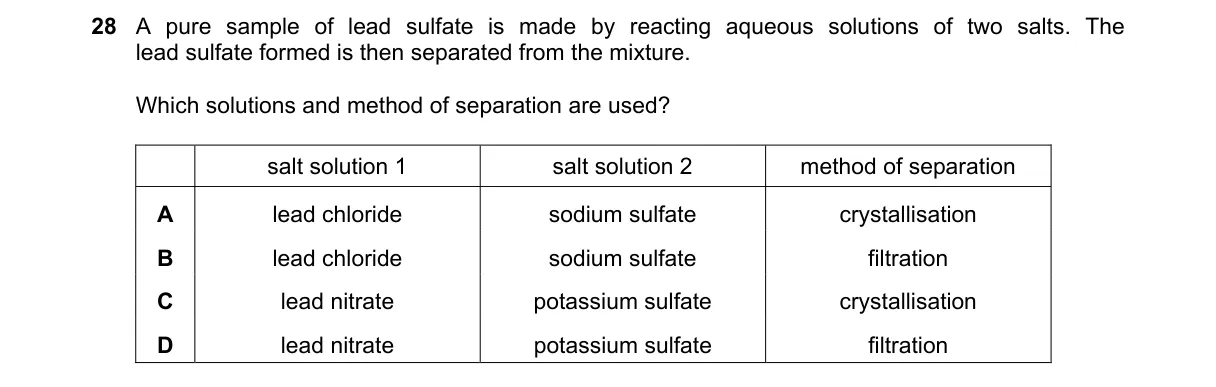
Answer choices
- Alead chloride, sodium sulfate, filtration
- Blead chloride, sodium sulfate, crystallisation
- Clead nitrate, potassium sulfate, crystallisation
- Dlead nitrate, potassium sulfate, filtration
Explanation
Precipitation Reaction and Filtration for Insoluble Lead Sulfate Steps:
- Identify soluble salts providing Pb²⁺ and SO₄²⁻ ions for double displacement: Pb(NO₃)₂ + K₂SO₄ → PbSO₄ ↓ + 2KNO₃.
- Confirm PbSO₄ is insoluble in water per solubility rules (sulfates of Pb²⁺ are insoluble).
- Recognize the solid precipitate forms directly in solution without dissolving.
- Select filtration to separate the insoluble solid from the aqueous mixture.
Why D is correct:
- PbSO₄ has low solubility (Ksp ≈ 1.6 × 10⁻⁸), forming a pure precipitate from soluble lead nitrate and potassium sulfate, isolated by filtration.
Why the others are wrong:
- A: Lead chloride is sparingly soluble (~1 g/100 mL), leading to impure or incomplete reaction in aqueous solution.
- B: Crystallization requires evaporating a solution of the product, but insoluble PbSO₄ does not dissolve.
- C: Crystallization is incorrect for separating an insoluble precipitate like PbSO₄.
Final answer: D
Topic: Preparation of salts
Practice more O Levels/IGCSE Chemistry (5070) questions on mMCQ.me