O Levels/IGCSE Chemistry (5070)•5070/11/M/J/22
O Levels/IGCSE Chemistry (5070) — 5070/11/M/J/22, Question 24
The table gives some information about four redox reactions. Which row gives correct information about what is oxidised and the evidence that this is oxidation?
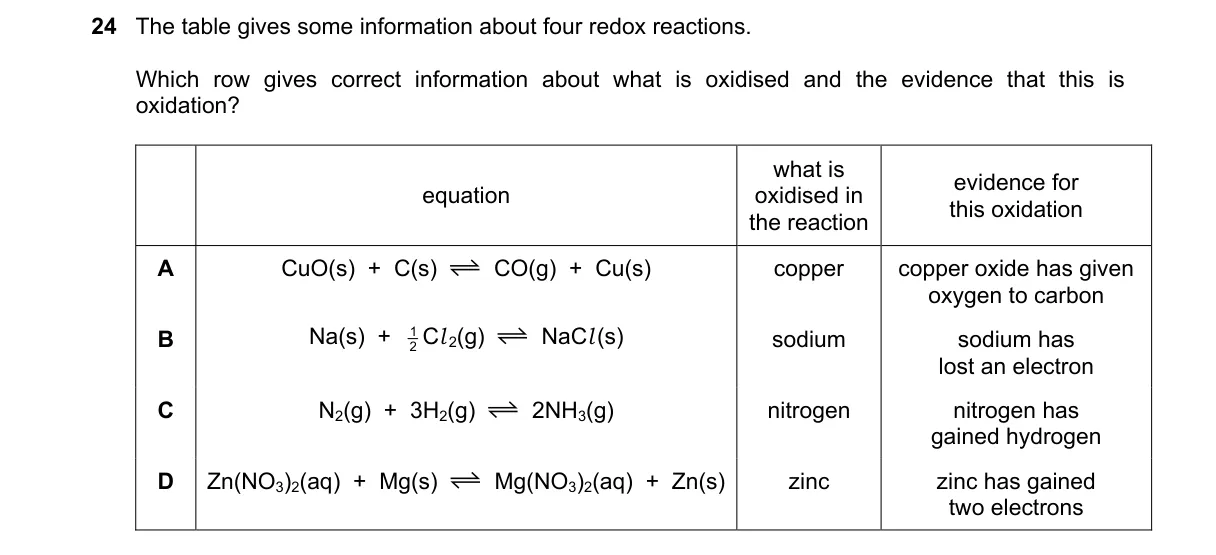
Answer choices
- ACuO(s) + C(s) → Cu(s) + CO2(g) copper this oxide has
- BNa(s) + Cl2(g) → NaCl(s) sodium has lost one electron
- CN2(g) + 3H2(g) → 2NH3(g) nitrogen lost an electron
- DZn(NO3)2(aq) + Mg(s) → Mg(NO3)2(aq) + Zn(s) zinc gained two electrons
Explanation
Oxidation involves loss of electrons Steps:
- Define oxidation as loss of electrons in a redox reaction.
- Examine each option for the substance oxidized and supporting evidence.
- Verify evidence matches electron transfer or oxidation state change.
- Identify the option with accurate identification and evidence.
Why B is correct:
- Sodium is oxidized from Na(0) to Na+(+1), losing one electron per atom, as per the definition of oxidation in redox reactions.
Why the others are wrong:
- A: CuO is reduced (Cu gains electrons); "this oxide has" provides no valid oxidation evidence.
- C: Nitrogen is reduced (gains electrons, oxidation state 0 to -3); it did not lose an electron.
- D: Zinc is reduced (gains two electrons); evidence incorrectly attributes gain to zinc instead of Mg's loss.
Final answer: B
Topic: Redox
Practice more O Levels/IGCSE Chemistry (5070) questions on mMCQ.me