O Levels/IGCSE Chemistry (5070)•5070/11/M/J/22
O Levels/IGCSE Chemistry (5070) — 5070/11/M/J/22, Question 20
Sulfur dioxide reacts with oxygen in the air. 2SO₂(g) + O₂(g) ⇌ 2SO₃(g) ΔH = -196 kJ/mol The reaction is very slow if no catalyst is present. Which statement explains this?
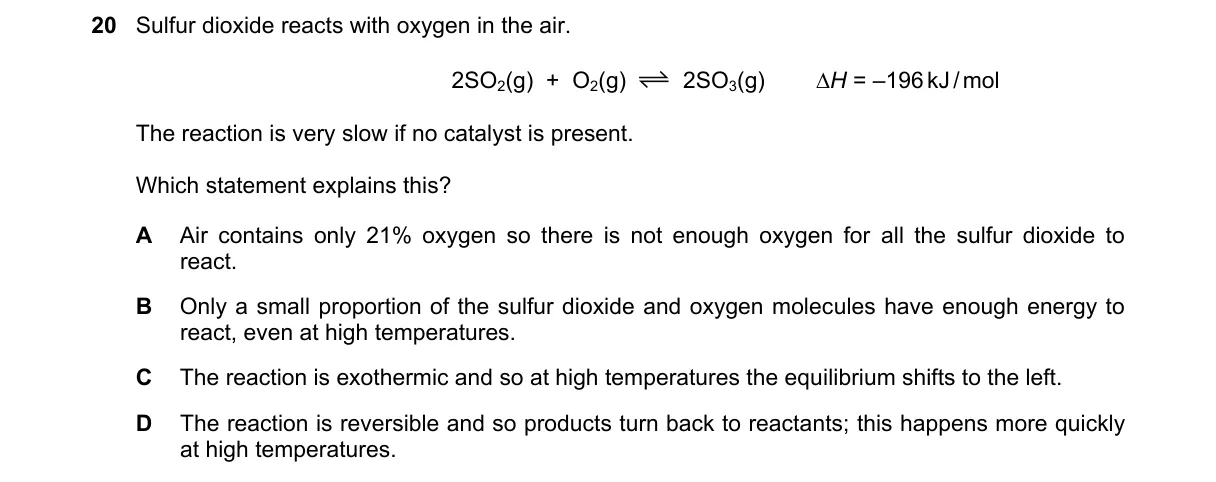
Answer choices
- AAir contains only 21% oxygen so there is not enough oxygen for all the sulfur dioxide
- BOnly a small proportion of the sulfur dioxide and oxygen molecules have enough energy to
- CThe reaction is exothermic and so at high temperatures the equilibrium shifts to the left.
- DThe reaction is reversible so products turn back to reactants: this happens more quickly at high temperatures.
Explanation
Activation Energy Barrier
Steps:
- Reaction rate depends on collisions between SO₂ and O₂ molecules with energy exceeding the activation energy (E_a).
- At ambient temperatures, only a small fraction of molecules possess this minimum E_a, leading to few successful collisions.
- Without a catalyst to lower E_a, the reaction proceeds slowly despite being thermodynamically favorable (exothermic).
- Catalysts increase the proportion of energetic molecules, but here none is present, explaining the slowness.
Why B is correct:
- Collision theory states that reaction rate is proportional to the fraction of molecules with energy ≥ E_a; B directly describes this low fraction without a catalyst.
Why the others are wrong:
- A: Oxygen concentration (21%) is sufficient; slowness is kinetic, not due to reactant shortage.
- C: Equilibrium position (Le Chatelier's principle) affects yield, not initial rate or catalyst absence.
- D: Reversibility impacts equilibrium, but slowness stems from high forward E_a, not temperature-driven reversal.
Final answer: B
Topic: Rate of reaction
Practice more O Levels/IGCSE Chemistry (5070) questions on mMCQ.me