O Levels/IGCSE Chemistry (5070)•5070/11/M/J/22
O Levels/IGCSE Chemistry (5070) — 5070/11/M/J/22, Question 13
Aqueous calcium hydroxide is an alkali. It is neutralised by dilute nitric acid to produce calcium nitrate and water. What is the ionic equation for this
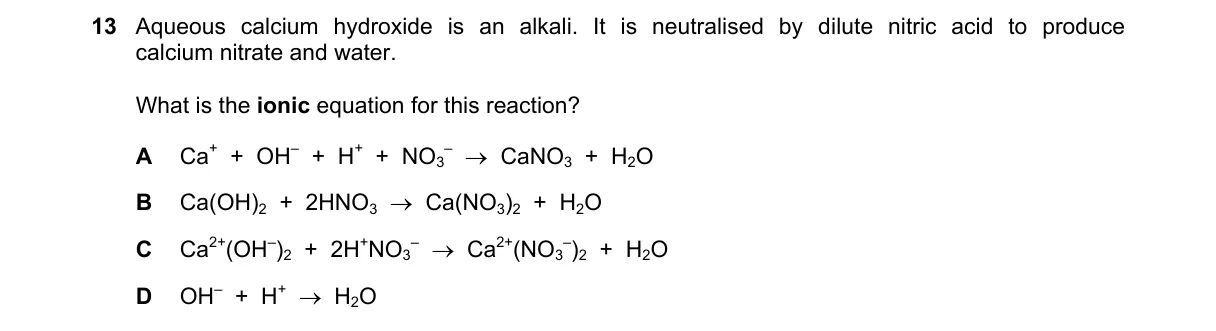
Answer choices
- ACa(OH)2 + H+ NO3- → CaNO3 + H2O
- BCa(OH)2 + 2HNO3 → Ca(NO3)2 + H2O
- COH- + H+ → H2O Ca2+ + 2NO3- → Ca(NO3)2
- DOH- + H+ → H2O Ca2+ + 2NO3- → Ca(NO3)2
Explanation
Net ionic equation for acid-base neutralization
Steps:
- Balance molecular equation: Ca(OH)₂(aq) + 2HNO₃(aq) → Ca(NO₃)₂(aq) + 2H₂O(l)
- Dissociate into ions: Ca²⁺ + 2OH⁻ + 2H⁺ + 2NO₃⁻ → Ca²⁺ + 2NO₃⁻ + 2H₂O
- Cancel spectator ions Ca²⁺ and 2NO₃⁻ from both sides
- Result: net ionic OH⁻ + H⁺ → H₂O, with salt from remaining ions Ca²⁺ + 2NO₃⁻
Why D is correct:
- Represents ionic equation by showing H⁺/OH⁻ combination to water and Ca²⁺/NO₃⁻ to salt, per definition of ionic equations focusing on reacting species.
Why the others are wrong:
- A: Includes undissociated species and wrong salt formula CaNO₃ (should be Ca(NO₃)₂)
- B: Full molecular equation, ignores dissociation into ions
- C: Lacks clear separation of neutralization and salt formation, misrepresenting net ionic form
Final answer: D
Topic: The characteristic properties of acids and bases
Practice more O Levels/IGCSE Chemistry (5070) questions on mMCQ.me