O Levels/IGCSE Chemistry (5070)•5070/12/M/J/21
O Levels/IGCSE Chemistry (5070) — 5070/12/M/J/21, Question 4
An aqueous solution of J is a colourless solution that contains cations and chloride ions. Separate hydroxide with a solution give a white precipitate with a few drops of aqueous ammonia. Which statement about J is correct?
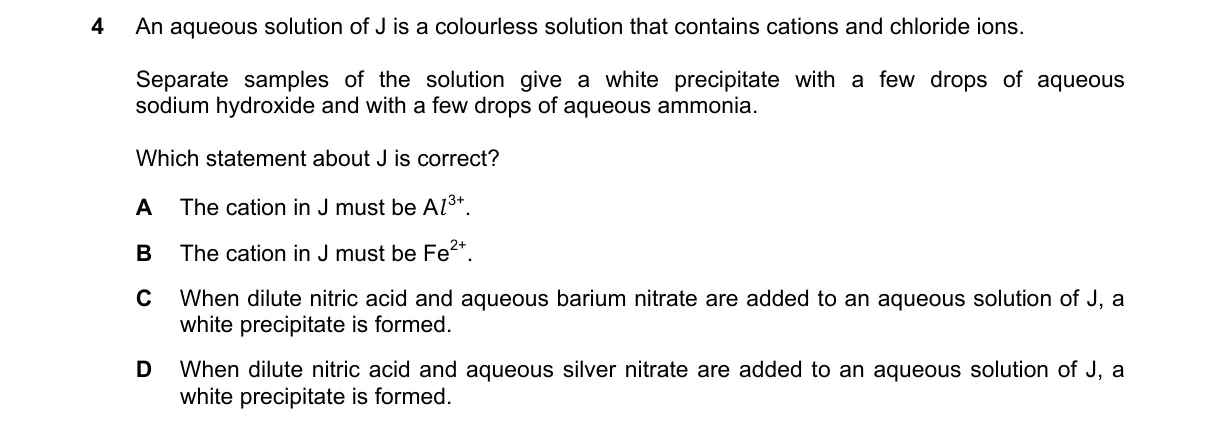
Answer choices
- AThe cation in J must be Ag+.
- BWhen dilute HNO3 and Ba(NO3)2 are added to aqueous solution of J
- CWhen dilute nitric acid and aqueous barium nitrate are added to an aqueous solution of J, a white precipitate is formed
- DAqueous silver nitrate is added to an aqueous solution of J, a white precipitate is formed
Explanation
Chloride ion confirmation test
Steps:
- J contains chloride ions (Cl⁻) and an unidentified cation.
- The cation forms a white hydroxide precipitate that dissolves in aqueous ammonia, indicating Zn²⁺ (Zn(OH)₂ → [Zn(NH₃)₄]²⁺).
- To confirm Cl⁻, add aqueous AgNO₃, which reacts with Cl⁻ to form insoluble AgCl.
- AgCl appears as a white precipitate, verifying Cl⁻ presence.
Why D is correct:
- AgNO₃ + Cl⁻ → AgCl (s) (white precipitate), standard test for chloride ions.
Why the others are wrong:
- A: Cation is Zn²⁺ (white Zn(OH)₂ dissolves in NH₃), not Ag⁺ (brown Ag₂O, insoluble in NH₃).
- B: Incomplete statement provides no testable information.
- C: Ba(NO₃)₂ + Cl⁻ → BaCl₂ (soluble, no precipitate); HNO₃ acidifies but doesn't form BaCl₂ ppt.
Final answer: D
Topic: Identification of ions and gases
Practice more O Levels/IGCSE Chemistry (5070) questions on mMCQ.me