O Levels/IGCSE Chemistry (5070)•5070/12/M/J/21
O Levels/IGCSE Chemistry (5070) — 5070/12/M/J/21, Question 36
Vegetable oils can be made into margarine. Which row describes the changes which take place?
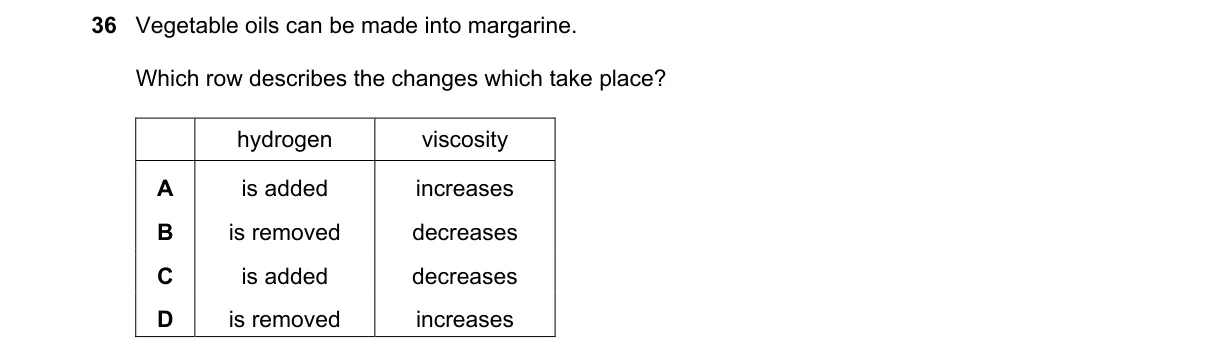
Answer choices
- Ahydrogen is added, viscosity decreases
- Bhydrogen is removed, viscosity decreases
- Chydrogen is added, viscosity increases
- Dhydrogen is removed, viscosity increases
Explanation
Hydrogenation of unsaturated oils to semi-solid margarine Steps:
- Vegetable oils contain unsaturated fatty acids with carbon-carbon double bonds, making them liquid with low viscosity.
- To produce margarine, partial hydrogenation adds hydrogen gas (with a catalyst) across some double bonds.
- This increases saturation, straightening fatty acid chains and raising the melting point.
- The product becomes a semi-solid spread with higher viscosity than the original liquid oil.
Why C is correct:
- Hydrogenation saturates double bonds per the reaction: C=C + H₂ → CH-CH, increasing intermolecular forces and viscosity as defined by resistance to flow in fats.
Why the others are wrong:
- A: Hydrogen is added, but viscosity increases due to solidification, not decreases.
- B: Hydrogen is added during hydrogenation, not removed; viscosity also increases.
- D: Hydrogen is added, not removed.
Final answer: C
Topic: Alkenes
Practice more O Levels/IGCSE Chemistry (5070) questions on mMCQ.me