O Levels/IGCSE Chemistry (5070)•5070/12/M/J/21
O Levels/IGCSE Chemistry (5070) — 5070/12/M/J/21, Question 33
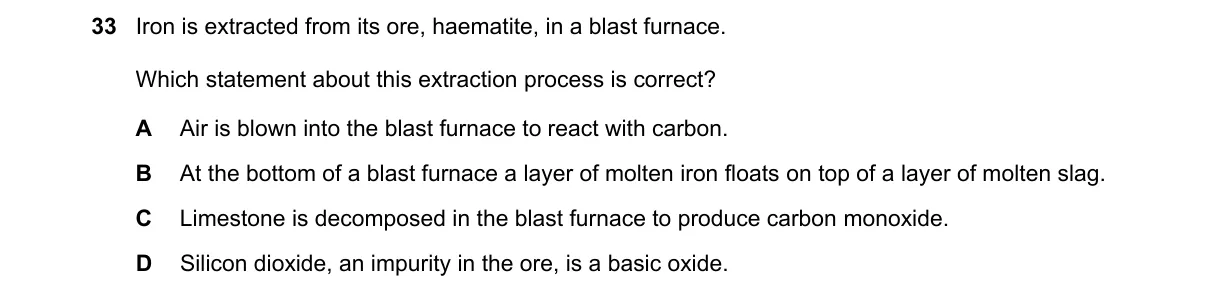
Iron is extracted from its ore, haematite, in a blast furnace. Which statement about this extraction process is correct?
Answer choices
- AAir is blown into the blast furnace to react with carbon.
- BAt the bottom of the blast furnace, the layer of molten iron is on top of the layer of molten slag.
- CLimestone is decomposed in the blast furnace to produce molten slag.
- DSilicon dioxide, an impurity in the ore, is a basic oxide.
Explanation
Blast Furnace Iron Extraction Process
Steps:
- Air provides oxygen that reacts with coke (carbon) to form carbon dioxide, which reduces to carbon monoxide for iron oxide reduction.
- Limestone decomposes to calcium oxide, reacting with silica impurities to form slag.
- Molten iron, being denser, sinks below the lighter slag layer at the furnace base.
- Silicon dioxide acts as an acidic oxide, neutralized by basic calcium oxide from limestone.
Why A is correct:
- Air's oxygen reacts with carbon in coke via 2C + O₂ → 2CO, producing CO that reduces Fe₂O₃ to Fe.
Why the others are wrong:
- B: Molten iron is denser than slag, so it forms the bottom layer with slag on top.
- C: Limestone decomposes to CaO (CaCO₃ → CaO + CO₂), but CaO then reacts with SiO₂ to form slag, not directly producing it.
- D: Silicon dioxide is an acidic oxide, not basic, as it reacts with bases like CaO.
Final answer: A
Topic: Extraction of metals
Practice more O Levels/IGCSE Chemistry (5070) questions on mMCQ.me