O Levels/IGCSE Chemistry (5070)•5070/12/M/J/21
O Levels/IGCSE Chemistry (5070) — 5070/12/M/J/21, Question 20
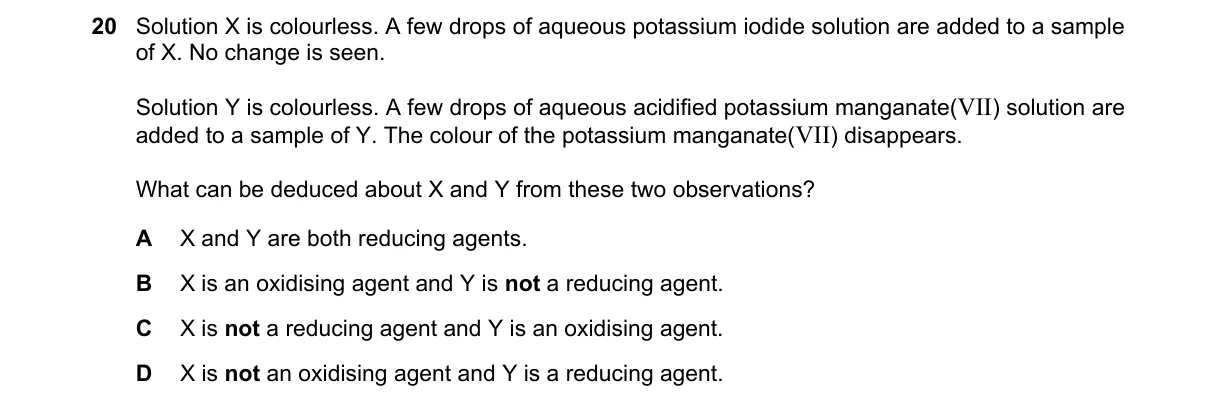
Solution X is colourless. A few drops of aqueous iodide solution are added to a sample of X. No change is seen. Solution Y is colourless. A few drops of aqueous acidified potassium manganate(VII) solution are added to a sample of Y. The colour of the potassium manganate(VII) disappears. What can be deduced about X and Y from these two observations?
Answer choices
- AX and Y are both reducing agents.
- BX is an oxidising agent and Y is a reducing agent.
- CX is not an oxidising agent and Y is an oxidising agent.
- DX is not an oxidising agent and Y is a reducing agent.
Explanation
Reactions distinguish oxidizing and reducing agents
Steps:
- Aqueous iodide (I⁻) is a reducing agent; no colour change (no I₂ formed) with X means X does not oxidize I⁻, so X is not an oxidizing agent.
- Acidified KMnO₄ (purple) is a strong oxidizing agent; its decolorization by Y means Y reduces MnO₄⁻ to Mn²⁺ (colourless), so Y is a reducing agent.
- Both solutions are colourless, ruling out interference from their own colours in observations.
- Deduction: X lacks oxidizing power, while Y has reducing power.
Why D is correct:
- D states X is not an oxidizing agent (no reaction with I⁻) and Y is a reducing agent (decolorizes KMnO₄), matching the tests' definitions of agent types.
Why the others are wrong:
- A: X shows no reducing/oxidizing activity toward I⁻, so not a reducing agent.
- B: X does not oxidize I⁻, contradicting X as oxidizing agent.
- C: Y reduces KMnO₄, so Y is reducing, not oxidizing.
Final answer: D
Topic: Redox
Practice more O Levels/IGCSE Chemistry (5070) questions on mMCQ.me