O Levels/IGCSE Chemistry (5070)•5070/12/M/J/21
O Levels/IGCSE Chemistry (5070) — 5070/12/M/J/21, Question 18
Aqueous sodium thiosulfate reacts with hydrochloric acid. The rate of reaction increases if concentration of sodium thiosulfate increases. Nitrogen gas reacts with hydrogen gas. The rate of reaction increases if pressure in the reaction vessel increases. Which row correctly explains why the change increases the rate of the reaction?
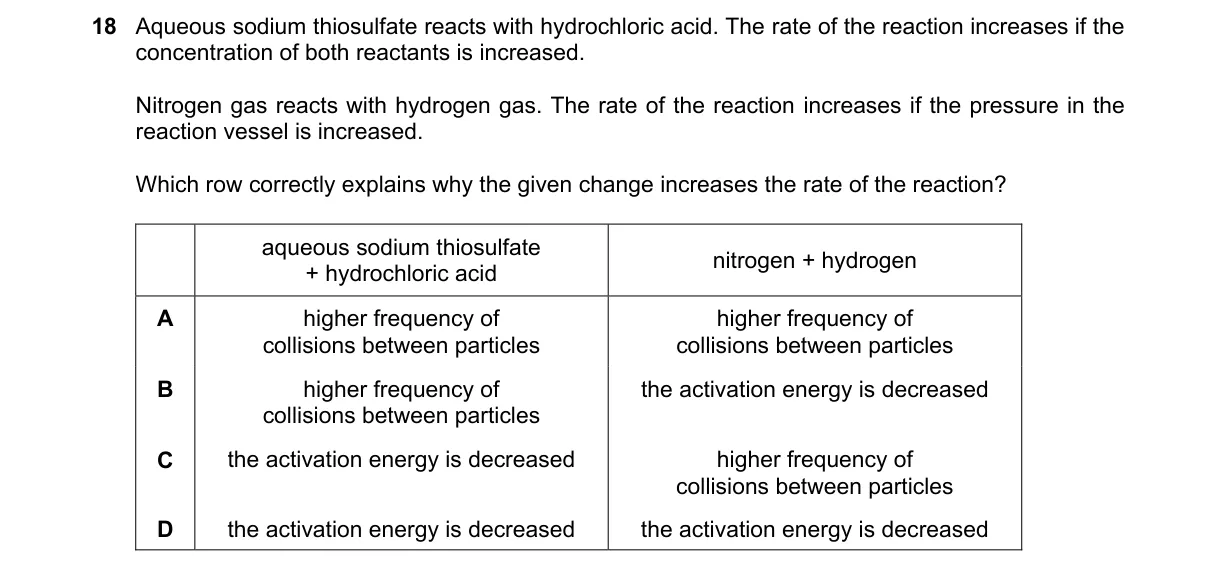
Answer choices
- Ahigher frequency of collisions between particles | higher frequency of collisions between particles
- Bhigher frequency of collisions between particles | the activation energy is decreased
- Cthe activation energy is decreased | higher frequency of collisions between particles
- Dthe activation energy is decreased | the activation energy is decreased
Explanation
Collision Theory and Reaction Rates
Steps:
- Recall collision theory: reaction rate depends on frequency of effective collisions between particles.
- For sodium thiosulfate and HCl: increasing concentration raises particle number, boosting collision frequency.
- For N2 and H2: increasing pressure compresses gases, raising particle density and collision frequency.
- Neither change affects activation energy, which remains constant.
Why A is correct:
- Collision theory states rate proportional to collision frequency; both changes increase collisions without altering activation energy.
Why the others are wrong:
- B: Pressure increases collision frequency, not activation energy.
- C: Concentration increases collisions, not activation energy.
- D: Neither factor decreases activation energy.
Final answer: A
Topic: Rate of reaction
Practice more O Levels/IGCSE Chemistry (5070) questions on mMCQ.me