O Levels/IGCSE Chemistry (5070)•5070/11/M/J/21
O Levels/IGCSE Chemistry (5070) — 5070/11/M/J/21, Question 32
Attaching pieces of magnesium to underground iron pipes protects the iron from corrosion. Which reaction protects the iron from corrosion?
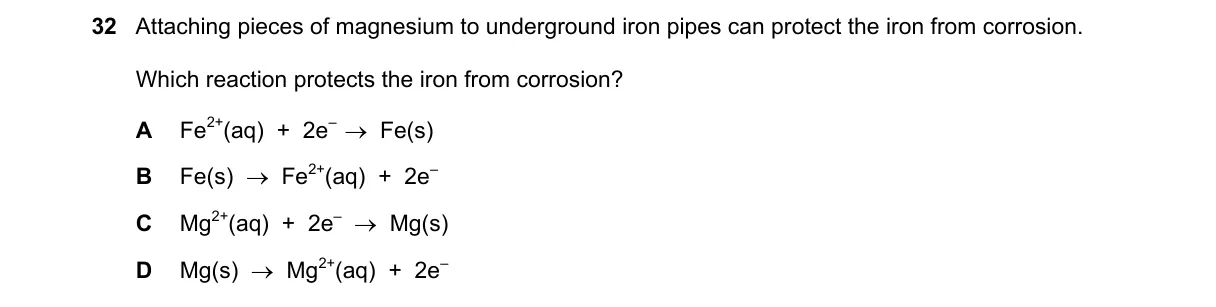
Answer choices
- AFe²⁺(aq) + 2e⁻ → Fe(s)
- BMg²⁺(aq) + 2e⁻ → Mg(s)
- CFe(s) + Mg²⁺(aq) → Fe²⁺(aq) + Mg(s)
- DMg(s) + Fe²⁺(aq) → Mg²⁺(aq) + Fe(s)
Explanation
Sacrificial Anode Protection Steps:
- Iron corrodes via oxidation: Fe(s) → Fe²⁺(aq) + 2e⁻.
- Magnesium, more reactive (higher in reactivity series), oxidizes preferentially: Mg(s) → Mg²⁺(aq) + 2e⁻.
- Electrons from Mg reduce Fe²⁺ ions: Fe²⁺(aq) + 2e⁻ → Fe(s).
- Overall: Mg displaces Fe²⁺, protecting iron.
Why D is correct:
- Represents the redox displacement where Mg acts as sacrificial anode, oxidizing to protect Fe per electrochemical series.
Why the others are wrong:
- A: Iron ion reduction alone; ignores Mg's role in providing electrons.
- B: Magnesium ion reduction; impossible as Mg is more easily oxidized.
- C: Reverse reaction; causes iron oxidation, worsening corrosion.
Final answer: D
Topic: Corrosion of metals
Practice more O Levels/IGCSE Chemistry (5070) questions on mMCQ.me