O Levels/IGCSE Chemistry (5070)•5070/11/M/J/21
O Levels/IGCSE Chemistry (5070) — 5070/11/M/J/21, Question 23
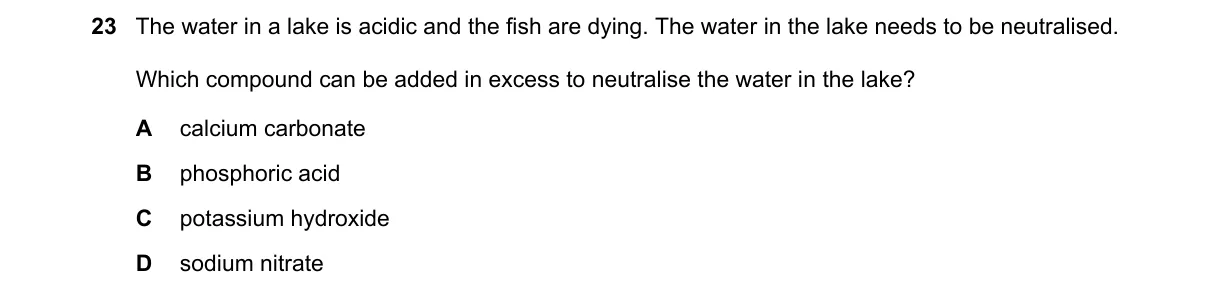
The water in a lake is acidic and the fish are dying. The water in the lake needs to be neutralised. Which compound can be added in excess to neutralise the water in the lake?
Answer choices
- Acalcium carbonate
- Bphosphoric acid
- Cpotassium hydroxide
- Dsodium nitrate
Explanation
Neutralizing acidic lake water safely with excess addition
Steps:
- Acidic lake water has excess H+ ions harming fish; neutralization requires a base to react with H+.
- The base must be addable in excess without over-alkalizing or toxifying the water.
- Evaluate options: bases react to form water and salts; acids worsen pH; neutrals do nothing.
- Select calcium carbonate, as it buffers mildly and excess remains harmless.
Why A is correct:
- Calcium carbonate neutralizes acids via CaCO3(s) + 2H+(aq) → Ca2+(aq) + H2O(l) + CO2(g), forming non-toxic products; excess is insoluble limestone, safe for aquatic life.
Why the others are wrong:
- B: Phosphoric acid (H3PO4) is an acid, adding more H+ and increasing acidity.
- C: Potassium hydroxide (KOH) is a strong base; excess raises pH too high, harming fish.
- D: Sodium nitrate (NaNO3) is a neutral salt, inert and unable to neutralize acids.
Final answer: A
Topic: The characteristic properties of acids and bases
Practice more O Levels/IGCSE Chemistry (5070) questions on mMCQ.me