O Levels/IGCSE Chemistry (5070)•5070/12/M/J/20
O Levels/IGCSE Chemistry (5070) — 5070/12/M/J/20, Question 7
{"stem": "The diagram shows the relative mass and relative charge of two particles, O and • in atoms and ions. Which of these particles are present in a hydrogen atom and in a hydrogen ion?", "choices": [{"label": "A", "text": "both O and • in H and both O and • in H+"}, {"label": "B", "text": "both O and • in H and but not O and • in H+"}, {"label": "C", "text": "both O and • in H and O but not • in H+"}, {"label": "D", "text": "O but not • in H and • but not O in H+"}]}
{"stem": "The diagram shows the relative mass and relative charge of two particles, O and • in atoms and ions. Which of these particles are present in a hydrogen atom and in a hydrogen ion?", "choices": [{"label": "A", "text": "both
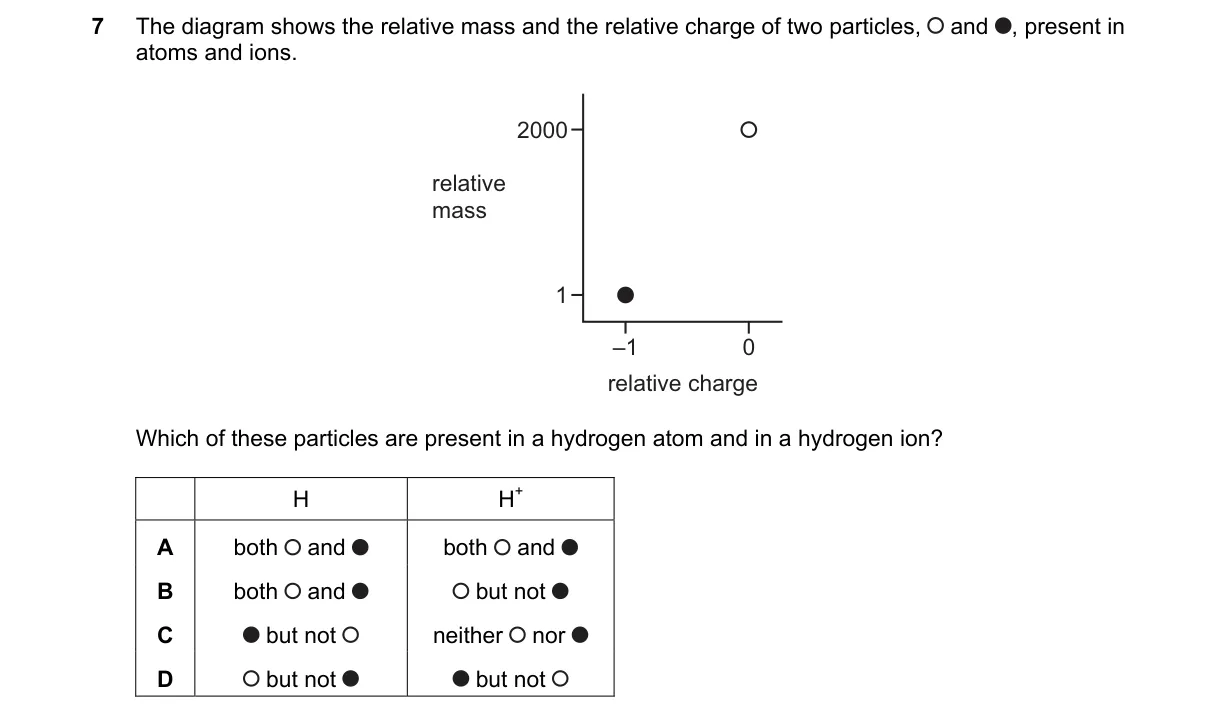
Answer choices
- AOption A
- BOption B
- COption C
- DOption D
Explanation
Subatomic particles in hydrogen species
Steps:
- Identify O as proton (relative mass 1, charge +1) and • as electron (relative mass ~0, charge -1) from typical diagrams.
- Recall hydrogen atom (H) has one proton and one electron for neutrality.
- Note hydrogen ion (H+) forms by losing the electron, leaving only the proton.
- Match to choices: both particles in H, only proton (O) in H+.
Why C is correct:
- Hydrogen ion (H+) is defined as a proton (H nucleus), excluding the electron per atomic structure.
Why the others are wrong:
- A: Incorrectly includes electron in H+, which is not present.
- B: Fails to specify particles in H+; implies neither, but proton exists.
- D: Reverses particles, placing electron in H+ and excluding proton from H.
Final answer: C
Topic: Atomic structure and the Periodic Table
Practice more O Levels/IGCSE Chemistry (5070) questions on mMCQ.me