O Levels/IGCSE Chemistry (5070)•5070/12/M/J/20
O Levels/IGCSE Chemistry (5070) — 5070/12/M/J/20, Question 25
Chlorine is passed into separate samples of aqueous potassium iodide and aqueous potassium bromide. In which solutions is there a colour change?
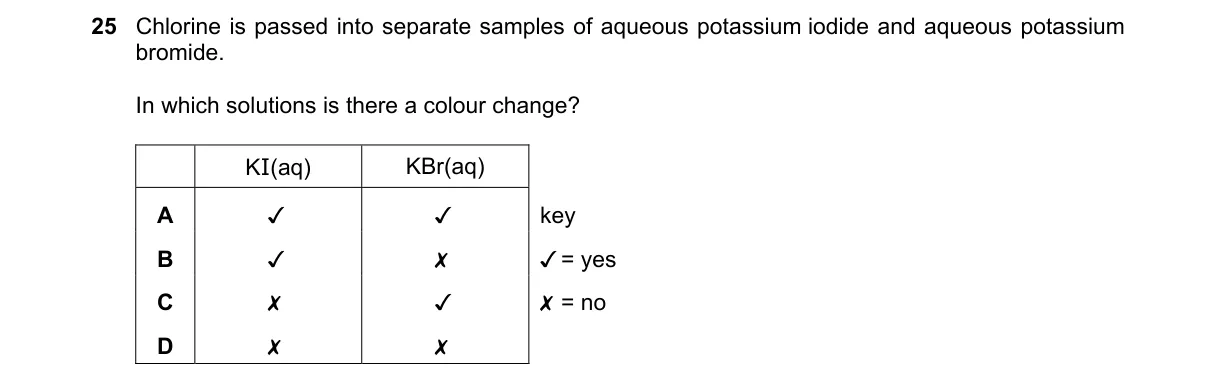
Answer choices
- AKI(aq) ✓ KBr(aq) ✓ yes
- BKI(aq) x KBr(aq) x no
- CKI(aq) ✓ KBr(aq) x no
- DKI(aq) x KBr(aq) ✓ no
Explanation
Halogen Displacement Reactions
Steps:
- Chlorine (Cl₂) is more reactive than bromine (Br₂) and iodine (I₂) in the reactivity series.
- In KI(aq), Cl₂ displaces I⁻ to form I₂: 2KI + Cl₂ → 2KCl + I₂ (colorless to brown).
- In KBr(aq), Cl₂ displaces Br⁻ to form Br₂: 2KBr + Cl₂ → 2KCl + Br₂ (colorless to yellow-orange).
- Both reactions produce visible colored products, causing color changes.
Why A is correct:
- Chlorine displaces less reactive bromide and iodide ions, forming colored Br₂ and I₂ as per the halogen reactivity series.
Why the others are wrong:
- B: Incorrect, as both solutions show color changes from displaced halogens.
- C: Incorrect, ignores color change in KBr(aq) from Br₂ formation.
- D: Incorrect, ignores color change in KI(aq) from I₂ formation.
Final answer: A
Topic: Group VII properties
Practice more O Levels/IGCSE Chemistry (5070) questions on mMCQ.me