O Levels/IGCSE Chemistry (5070)•5070/12/M/J/20
O Levels/IGCSE Chemistry (5070) — 5070/12/M/J/20, Question 18
Which change in conditions, for the reaction between zinc and dilute sulfuric acid, increases the rate of reaction by lowering activation energy?
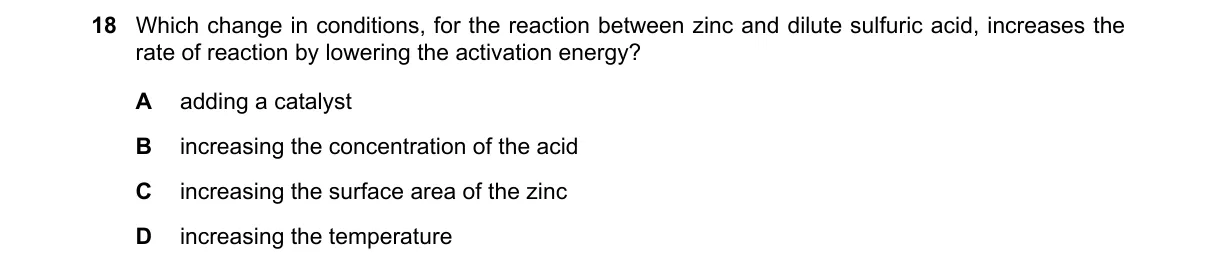
Answer choices
- Aadding a catalyst
- Bincreasing the surface area of the zinc
- Cincreasing the concentration of the acid
- Dincreasing the temperature
Explanation
Catalysts Reduce Activation Energy in Reactions
Steps:
- Define activation energy as the minimum energy barrier for reactants to form products.
- Recall that reaction rate depends on factors like collision frequency and activation energy.
- Evaluate each option: only catalysts directly alter the energy pathway.
- Confirm that lowering activation energy speeds up the reaction without changing other conditions.
Why A is correct:
- Catalysts provide an alternative reaction pathway with lower activation energy, increasing the rate constant per the Arrhenius equation (k = A e^(-Ea/RT)).
Why the others are wrong:
- B: Increases surface area boosts collision frequency between particles, not activation energy.
- C: Raises acid concentration increases reactant collisions, without affecting activation energy.
- D: Elevates temperature gives particles more kinetic energy to surpass the activation energy barrier, but does not lower it.
Final answer: A
Topic: Rate of reaction
Practice more O Levels/IGCSE Chemistry (5070) questions on mMCQ.me