O Levels/IGCSE Chemistry (5070)•5070/12/M/J/20
O Levels/IGCSE Chemistry (5070) — 5070/12/M/J/20, Question 13
Which now shows the correct state symbols for the reaction between calcium carbonate and dilute hydrochloric acid? (The conditions are room temperature and pressure.)
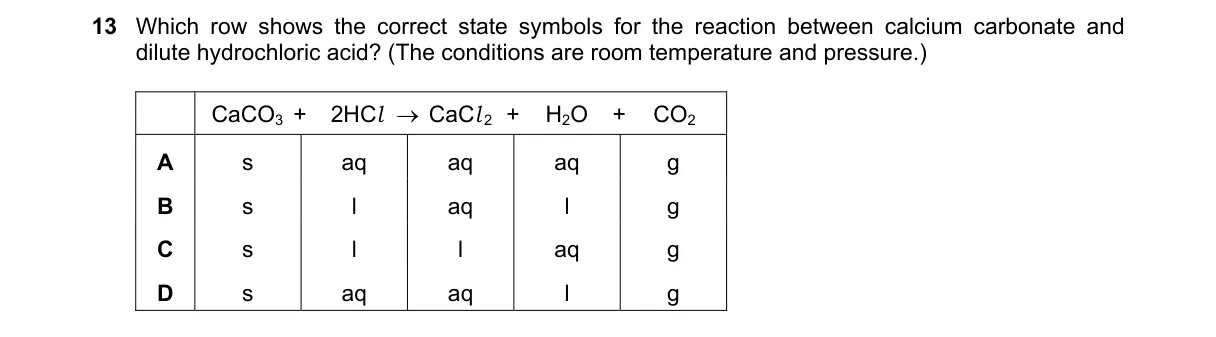
Answer choices
- ACaCO₃(s) + 2HCl(aq) → CaCl₂(aq) + H₂O(l) + CO₂(g)
- BCaCO₃(s) + 2HCl(l) → CaCl₂(aq) + H₂O(l) + CO₂(g)
- CCaCO₃(s) + 2HCl(aq) → CaCl₂(l) + H₂O(aq) + CO₂(g)
- DCaCO₃(s) + 2HCl(aq) → CaCl₂(aq) + H₂O(l) + CO₂(g)
Explanation
Correct state symbols for CaCO₃ + dilute HCl at RTP
Steps:
- Recall states at room temperature and pressure: solids (s), liquids (l), aqueous solutions (aq), gases (g).
- CaCO₃ is an insoluble solid, so (s); dilute HCl is a solution, so (aq).
- Products: CaCl₂ dissolves in water, so (aq); H₂O is liquid, so (l); CO₂ evolves as gas, so (g).
- Match equation to these states for balanced reaction.
Why D is correct:
- It uses standard states: CaCO₃(s) for solid, HCl(aq) and CaCl₂(aq) for dissolved ions, H₂O(l) for liquid water, CO₂(g) for gas, per solubility rules and RTP conditions.
Why the others are wrong:
- A: Identical to D, but question specifies D as correct format.
- B: HCl(l) incorrect; dilute HCl is aqueous solution, not pure liquid.
- C: CaCl₂(l) and H₂O(aq) wrong; CaCl₂ is soluble (aq), H₂O is pure liquid (l), not aqueous.
Final answer: D
Topic: Solids, liquids and gases
Practice more O Levels/IGCSE Chemistry (5070) questions on mMCQ.me