O Levels/IGCSE Chemistry (5070)•5070/11/M/J/20
O Levels/IGCSE Chemistry (5070) — 5070/11/M/J/20, Question 18
Pieces zinc added aqueous copper sulfate. Cu(aq) + Zn(s) → Zn(aq) + Cu(s) Which statement is correct?
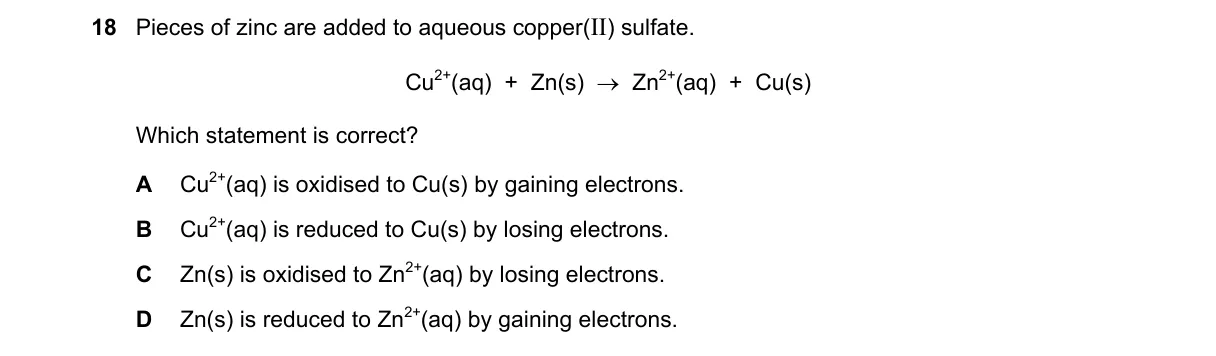
Answer choices
- ACu(aq) is reduced to Cu(s) by gaining electrons.
- BCu(aq) is oxidized to Cu(s) by gaining electrons.
- CZn(s) is reduced to Zn(aq) by gaining electrons.
- DZn(s) is oxidized to Zn(aq) by losing electrons.
Explanation
Redox processes in displacement reaction Steps:
- Identify the reaction type: single displacement where Zn replaces Cu, indicating a redox process.
- Split into half-reactions: Zn(s) → Zn²⁺(aq) + 2e⁻ (oxidation); Cu²⁺(aq) + 2e⁻ → Cu(s) (reduction).
- Apply definitions: oxidation = loss of electrons; reduction = gain of electrons.
- Evaluate options against half-reactions to find matching statements.
Why D is correct:
- Zn(s) loses 2 electrons to form Zn²⁺(aq), matching the definition of oxidation (LEO: loss of electrons is oxidation).
Why the others are wrong:
- A: Cu(aq) is reduced by gaining electrons, but this describes the copper half-reaction, not the focus on zinc's role.
- B: Oxidation involves losing electrons, not gaining; Cu(aq) is reduced.
- C: Zn(s) is oxidized by losing electrons, not reduced by gaining.
Final answer: D
Topic: Redox
Practice more O Levels/IGCSE Chemistry (5070) questions on mMCQ.me