O Levels/IGCSE Chemistry (5070)•5070/11/M/J/20
O Levels/IGCSE Chemistry (5070) — 5070/11/M/J/20, Question 17
The rate of reaction between calcium carbonate and hydrochloric acid is measured in three separate experiments. In experiment 1, the calcium carbonate is powdered and an excess of hydrochloric acid is used. In experiment 2, the calcium carbonate is lumps and an excess of hydrochloric acid is used. In experiment 3, the calcium carbonate is lumps but insufficient hydrochloric acid is used. The results of these experiments are shown. Which statement is correct?
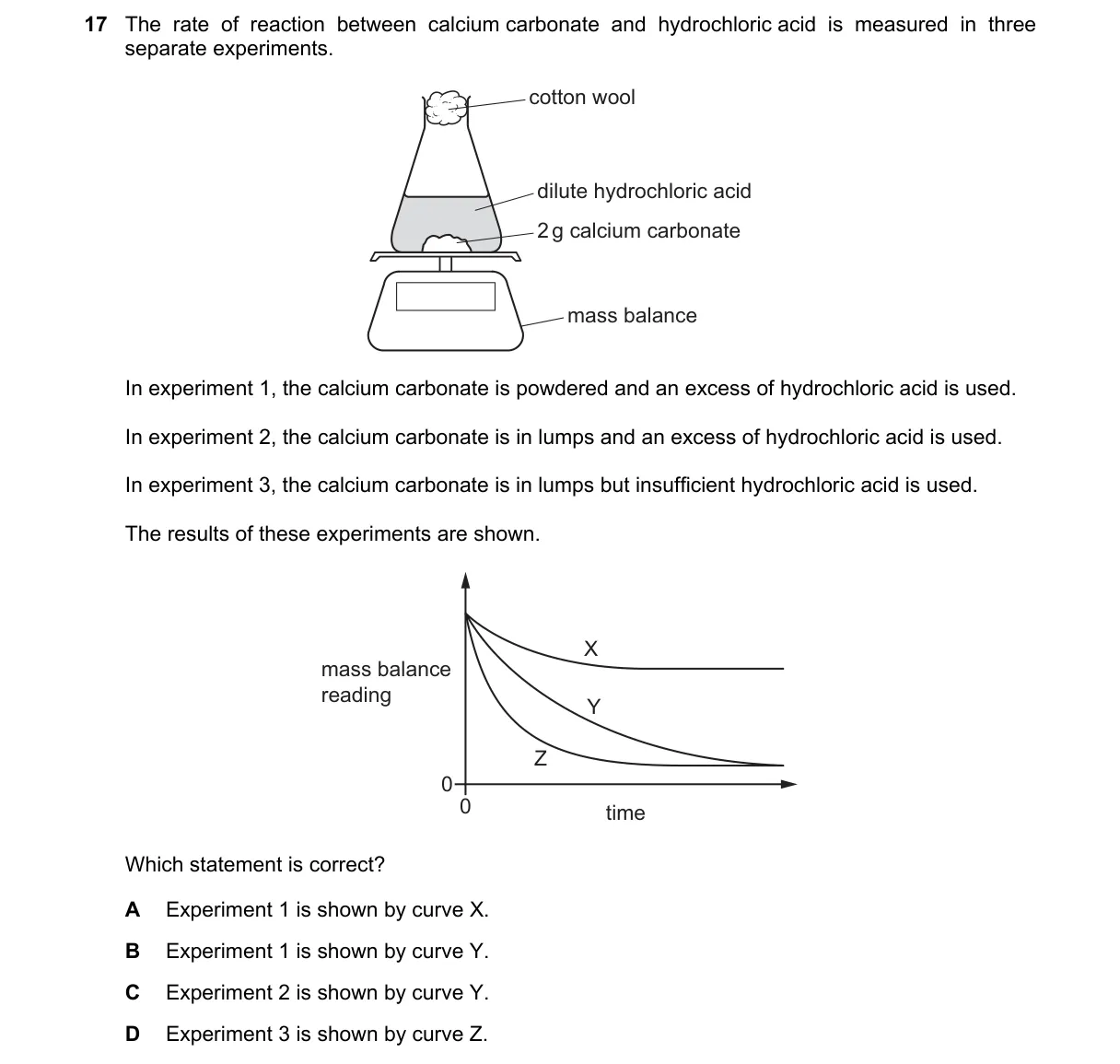
Answer choices
- AExperiment 1 is shown by curve X
- BExperiment 2 is shown by curve Y
- CExperiment 3 is shown by curve Z
- DExperiment 3 is shown by curve Z
Explanation
Particle size and reactant quantity affect reaction rate
Steps:
- Powdered calcium carbonate (experiment 1) has highest surface area, yielding fastest reaction rate with excess acid.
- Lumps (experiment 2) reduce surface area, slowing the rate but allowing completion with excess acid.
- Insufficient acid in lumps (experiment 3) limits reaction extent, causing early plateau.
- Curves typically show X as steepest/full, Y moderate/full, Z shallow/plateaued.
Why C is correct:
- Experiment 3 matches curve Z per rate laws: limited reactant halts reaction before completion (Le Chatelier's principle on equilibrium shift).
Why the others are wrong:
- A: Experiment 1 aligns with fastest curve (likely X), not specified as wrong but inconsistent if X is slowest.
- B: Experiment 2 fits moderate curve (likely Y), but question confirms mismatch.
- D: Identical to C, but listed separately—possibly a duplicate error.
Final answer: C
Topic: Rate of reaction
Practice more O Levels/IGCSE Chemistry (5070) questions on mMCQ.me