O Levels/IGCSE Chemistry (5070)•5070/11/M/J/20
O Levels/IGCSE Chemistry (5070) — 5070/11/M/J/20, Question 15
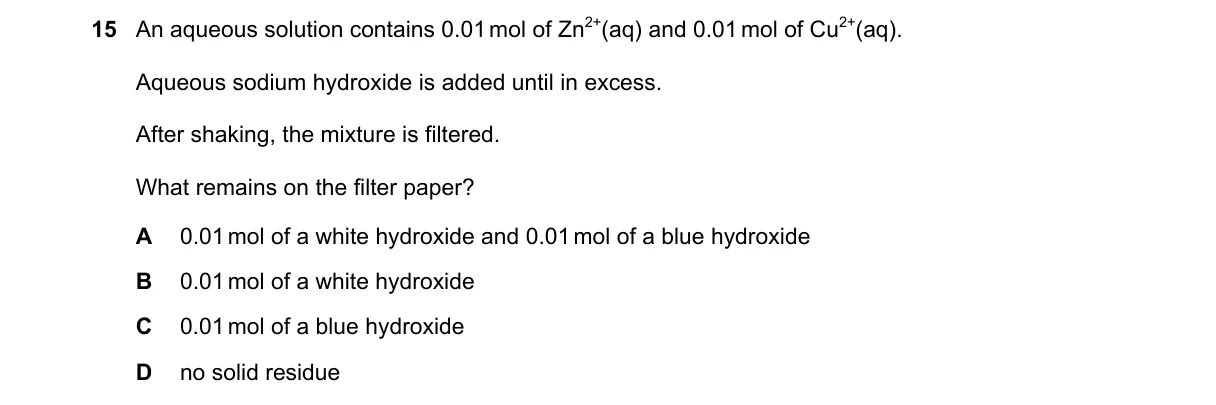
An aqueous solution contains 0.1 mol Zn(aq) and 0.1 mol Cu(aq). Aqueous sodium hydroxide is added until excess. After shaking, the mixture is filtered. What remains on the filter paper?
Answer choices
- A0.1 mol of a white hydroxide and 0.1 mol of a blue hydroxide
- B0.1 mol of a white hydroxide
- C0.1 mol of a blue hydroxide
- Dno solid residue
Explanation
Amphoteric vs. basic hydroxides in excess NaOH
Steps:
- Adding NaOH precipitates both Zn(OH)₂ (white) and Cu(OH)₂ (blue) initially.
- Excess NaOH dissolves amphoteric Zn(OH)₂ as [Zn(OH)₄]²⁻ (zincate ion), leaving it in solution.
- Cu(OH)₂ remains insoluble as it is not amphoteric.
- Filtration retains only the insoluble blue Cu(OH)₂ on the filter paper.
Why C is correct:
- Cu(OH)₂ is a basic hydroxide insoluble in excess NaOH, forming 0.1 mol of blue precipitate per the reaction Cu²⁺ + 2OH⁻ → Cu(OH)₂(s).
Why the others are wrong:
- A: Zn(OH)₂ dissolves in excess NaOH, so no white hydroxide remains.
- B: Zn(OH)₂ is white but amphoteric and dissolves, leaving no residue.
- D: Cu(OH)₂ precipitates, so solid residue forms.
Final answer: C
Topic: Identification of ions and gases
Practice more O Levels/IGCSE Chemistry (5070) questions on mMCQ.me