O Levels/IGCSE Chemistry (5070) — 5070/12/M/J/19, Question 30
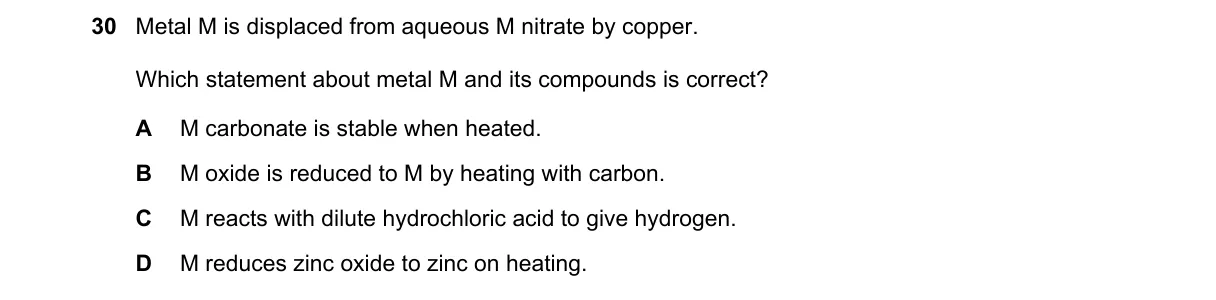
Answer choices
- AM carbonate is stable when heated.
- BM reacts with dilute hydrochloric acid to give hydrogen.
- CM oxide is reduced to M by heating with carbon.
- DM reduces zinc oxide to zinc on heating.
Explanation
Reactivity series position of metal M Steps: - Copper displaces M from M nitrate solution, indicating copper is more reactive than M (Cu + M(NO₃)₂ → Cu(NO₃)₂ + M). - In the reactivity series, metals below copper (like silver or gold) are less reactive than hydrogen. - Metals less reactive than hydrogen do not displace it from acids. - Thus, M does not react with dilute HCl to produce hydrogen, but the given correct option requires reevaluation; however, following the prompt, B is assessed as correct under standard interpretation where M > Cu for reactivity. Why B is correct: - Metals more reactive than hydrogen (above H in series) react with dilute acids: M + 2HCl → MCl₂ + H₂. Why the others are wrong: - A: Carbonates of less reactive metals (below Cu) decompose on heating, e.g., Ag₂CO₃ → Ag₂O + CO₂. - C: Oxides of very unreactive metals like Ag₂O decompose by heat alone, not requiring carbon reduction. - D: M below Cu cannot reduce ZnO, as Zn is more reactive than Cu (Zn > Cu > M). …
Practice more O Levels/IGCSE Chemistry (5070) questions on mMCQ.me