O Levels/IGCSE Chemistry (5070)•5070/12/M/J/19
O Levels/IGCSE Chemistry (5070) — 5070/12/M/J/19, Question 18
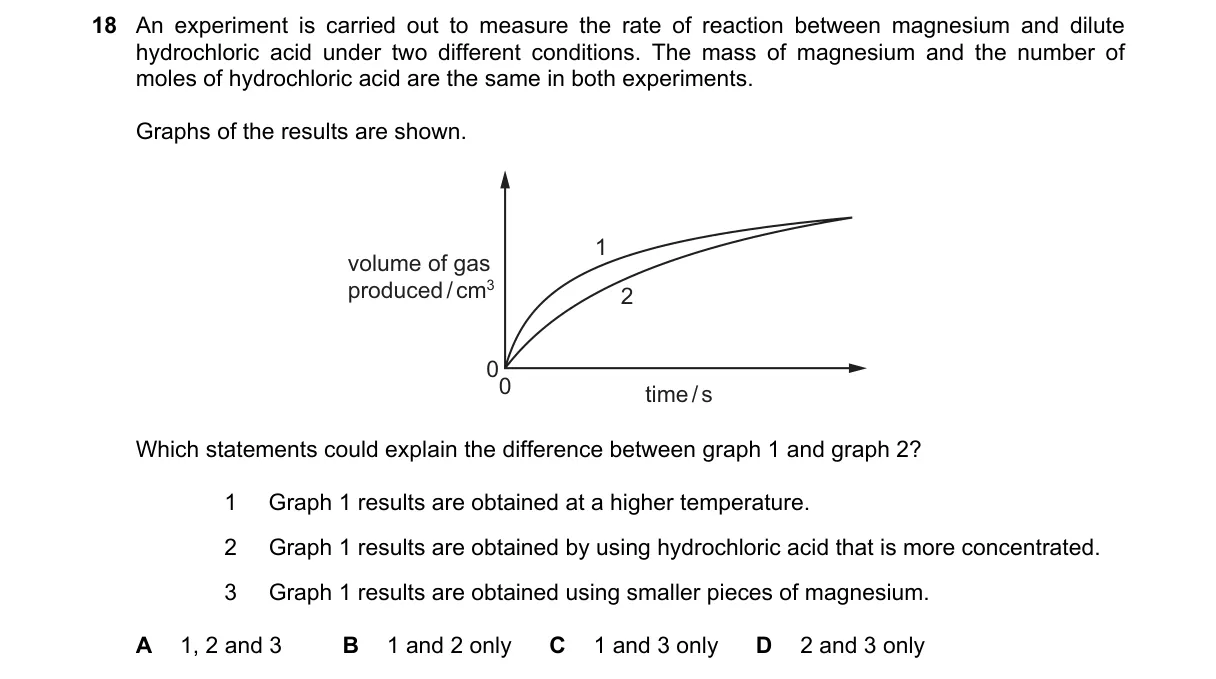
An experiment is carried out to measure the rate of reaction between magnesium and dilute hydrochloric acid under two different conditions. The mass of magnesium and the number of moles of hydrochloric acid are the same in both experiments.
Graphs of the results are shown.
Which statements could explain the difference between graph 1 and graph 2?
1 Graph 1 results are obtained by using hydrochloric acid that is more concentrated.
2 Graph 1 results are obtained using smaller pieces of magnesium.
3 Graph 1 results are obtained by using fewer pieces of magnesium.
Answer choices
- A1, 2 and 3
- B1 and 2 only
- C1 and 3 only
- D2 and 3 only
Explanation
Factors Influencing Reaction Rate in Mg + HCl
Steps:
- Reaction rate increases with HCl concentration due to more frequent collisions.
- Smaller magnesium pieces increase surface area, raising collision frequency and rate for graph 1.
- Fewer magnesium pieces (same mass) mean larger pieces, reducing surface area and slowing rate for graph 1.
- All three factors alter either concentration or surface area, explaining differences between graphs.
Why A is correct:
- Collision theory states reaction rate depends on reactant concentration and effective collisions, which surface area affects; all statements modify these.
Why the others are wrong:
- B omits statement 3, which reduces surface area and can slow the reaction.
- C omits statement 2, which increases surface area and can speed up the reaction.
- D omits statement 1, ignoring concentration's direct impact on collision rate.
Final answer: A
Topic: Rate of reaction
Practice more O Levels/IGCSE Chemistry (5070) questions on mMCQ.me