O Levels/IGCSE Chemistry (5070)•5070/12/M/J/19
O Levels/IGCSE Chemistry (5070) — 5070/12/M/J/19, Question 10
Powdered calcium carbonate reacts with dilute hydrochloric acid to produce calcium chloride, water and carbon dioxide. What is the correct ionic equation for this reaction?
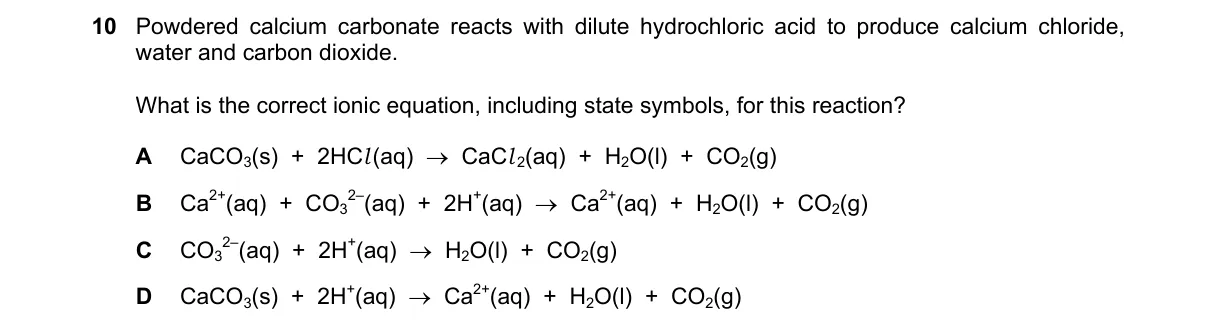
Answer choices
- ACaCO3(s) + 2HCl(aq) → CaCl2(aq) + H2O(l) + CO2(g)
- BCa2+(aq) + CO32-(aq) + 2H+(aq) → Ca2+(aq) + 2Cl-(aq) + H2O(l) + CO2(g)
- CCaCO3(s) + 2H+(aq) → Ca2+(aq) + H2O(l) + CO2(g)
- DCaCO3(s) + 2H+(aq) → Ca2+(aq) + CO32-(aq) + H2O(l) + CO2(g)
Explanation
Net Ionic Equation for Acid-Carbonate Reaction Steps:
- Write the molecular equation: CaCO3(s) + 2HCl(aq) → CaCl2(aq) + H2O(l) + CO2(g).
- Dissociate strong electrolyte HCl into 2H+(aq) + 2Cl-(aq) and CaCl2 into Ca2+(aq) + 2Cl-(aq); CaCO3 remains undissociated as solid.
- Form complete ionic equation: CaCO3(s) + 2H+(aq) + 2Cl-(aq) → Ca2+(aq) + 2Cl-(aq) + H2O(l) + CO2(g).
- Cancel spectator ions (2Cl-) to get net ionic equation: CaCO3(s) + 2H+(aq) → Ca2+(aq) + H2O(l) + CO2(g).
Why C is correct:
- It represents the net ionic equation by excluding spectators and showing only the essential reaction where H+ reacts with solid CaCO3 to form Ca2+, H2O, and CO2, per standard ionic equation rules.
Why the others are wrong:
- A: Full molecular equation, includes undissociated HCl and CaCl2.
- B: Incorrectly dissociates insoluble CaCO3 into ions on reactant side.
- D: Adds extraneous CO32-(aq) on product side, violating conservation of charge and mass.
Final answer: C
Topic: The characteristic properties of acids and bases
Practice more O Levels/IGCSE Chemistry (5070) questions on mMCQ.me