O Levels/IGCSE Chemistry (5070)•5070/11/M/J/19
O Levels/IGCSE Chemistry (5070) — 5070/11/M/J/19, Question 30
A power cable requires an element that: 1 conducts electricity 2 has a relatively low density 3 is resistant to aerial oxidation. Which of these conditions does aluminum satisfy?
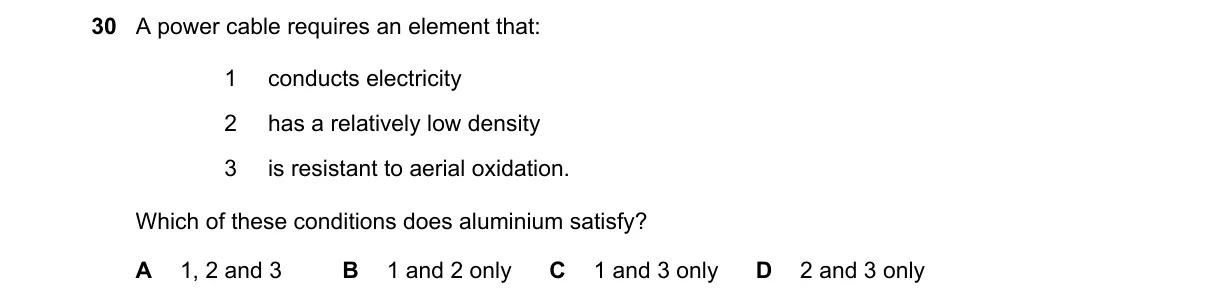
Answer choices
- A1, 2 and 3
- B1 and 2 only
- C1 and 3 only
- D2 and 3 only
Explanation
Aluminum Meets All Criteria for Power Cables
Steps:
- Verify conductivity: Aluminum is a metal with free electrons, enabling high electrical conductivity (second to copper among common metals).
- Check density: Aluminum's density is 2.70 g/cm³, lower than copper's 8.96 g/cm³, making it relatively lightweight for cables.
- Assess oxidation resistance: Aluminum forms a thin, adherent Al₂O₃ layer that passivates the surface, preventing further aerial oxidation.
- Conclude: All three conditions are satisfied, matching option A.
Why A is correct:
- Aluminum's properties align with requirements: metallic conductivity for electricity, density <3 g/cm³ for low weight, and oxide layer per corrosion science for oxidation resistance.
Why the others are wrong:
- B: Ignores aluminum's proven oxidation resistance in power lines.
- C: Overlooks aluminum's low density advantage over alternatives like copper.
- D: Excludes aluminum's essential electrical conductivity as a metal.
Final answer: A
Topic: Uses of metals
Practice more O Levels/IGCSE Chemistry (5070) questions on mMCQ.me