O Levels/IGCSE Chemistry (5070)•5070/11/M/J/19
O Levels/IGCSE Chemistry (5070) — 5070/11/M/J/19, Question 2
After acidification with dilute nitric acid, a colourless solution X reacts with aqueous silver nitrate to give a white precipitate. What could X be?
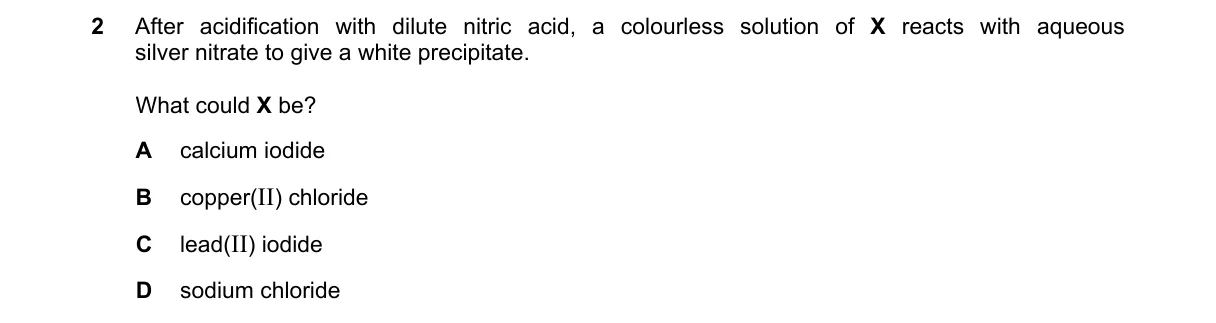
Answer choices
- Acalcium iodide
- Bcopper(I) chloride
- Clead(II) iodide
- Dsodium chloride
Explanation
Silver nitrate test distinguishes chloride via white precipitate
Steps:
- Acidify with dilute HNO3 to remove interfering anions like carbonate and ensure halide ions are free.
- Add aqueous AgNO3: forms AgX precipitate; color identifies halide (Cl- white, Br- cream, I- yellow).
- X must yield colourless solution post-acidification and white AgCl ppt.
- Test options: only soluble chloride fits both criteria.
Why D is correct:
- NaCl fully dissociates in water to Na+ and Cl-; Ag+ + Cl- → AgCl (white, insoluble per solubility rules).
Why the others are wrong:
- A: CaI2 provides I-; Ag+ + I- → AgI (yellow ppt).
- B: CuCl insoluble in water, yields no colourless solution; Cu(I) unstable in aqueous acid.
- C: PbI2 insoluble, yields no colourless solution; would give yellow AgI anyway.
Final answer: D
Topic: Identification of ions and gases
Practice more O Levels/IGCSE Chemistry (5070) questions on mMCQ.me