O Levels/IGCSE Chemistry (5070)•5070/11/M/J/19
O Levels/IGCSE Chemistry (5070) — 5070/11/M/J/19, Question 10
Powdered calcium carbonate reacts with dilute hydrochloric acid to produce calcium chloride, water and carbon dioxide. What is the correct ionic equation for this reaction?
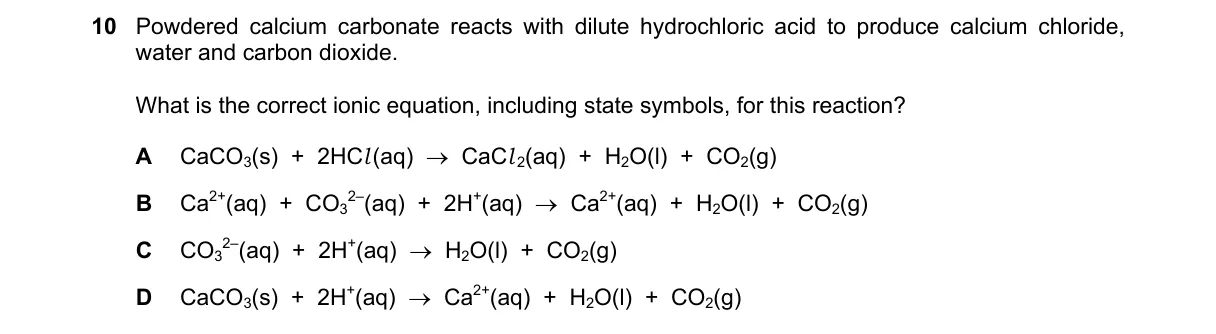
Answer choices
- ACaCO₃(s) + 2HCl(aq) → CaCl₂(aq) + H₂O(l) + CO₂(g)
- BCa²⁺(aq) + CO₃²⁻(aq) + 2H⁺(aq) → Ca²⁺(aq) + 2Cl⁻(aq) + H₂O(l) + CO₂(g)
- CCaCO₃(s) + 2H⁺(aq) → Ca²⁺(aq) + H₂O(l) + CO₂(g)
- DCaCO₃(s) + 2H⁺(aq) → Ca²⁺(aq) + H₂O(l) + CO₃²⁻(aq)
Explanation
Net Ionic Equation for Acid-Carbonate Reaction
Steps:
- Write the balanced molecular equation: CaCO₃(s) + 2HCl(aq) → CaCl₂(aq) + H₂O(l) + CO₂(g).
- Identify spectator ions: Cl⁻(aq) does not participate, so remove 2HCl and CaCl₂.
- Form net ionic equation: CaCO₃(s) + 2H⁺(aq) → Ca²⁺(aq) + H₂O(l) + CO₂(g).
- Verify balance: Atoms and charges match on both sides.
Why C is correct:
- It represents the net ionic equation, excluding spectators, per ionic equation rules showing only reacting species.
Why the others are wrong:
- A: Full molecular equation, includes spectators like Cl⁻.
- B: Dissolves solid CaCO₃ into ions incorrectly; it's insoluble.
- D: Produces CO₃²⁻(aq) instead of CO₂(g), violating the reaction's gas evolution.
Final answer: C
Topic: The characteristic properties of acids and bases
Practice more O Levels/IGCSE Chemistry (5070) questions on mMCQ.me