O Levels/IGCSE Chemistry (5070)•5070/12/M/J/18
O Levels/IGCSE Chemistry (5070) — 5070/12/M/J/18, Question 8
Ethane, C₂H₆, and ammonia, NH₃, are covalent compounds. The dot-and-cross diagrams of these compounds are shown. Which statements are correct 1 A molecule of ethane contains twice as many hydrogen atoms as a molecule of ammonia. 2 An unreacted nitrogen atom has five outer electrons. 3 In a molecule of ammonia, the bond between the nitrogen and each hydrogen atom is formed by sharing two electrons, one from each atom.
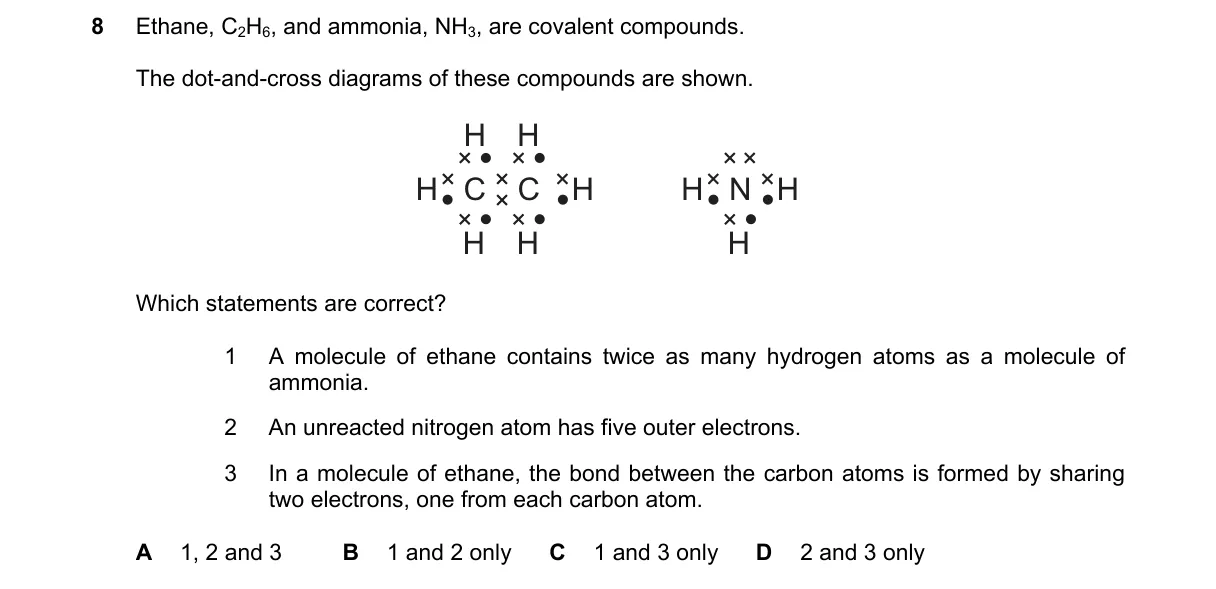
Answer choices
- A1, 2 and 3
- B1 and 2 only
- C1 and 3 only
- D2 and 3 only
Explanation
Verifying molecular structures and bonding in ethane and ammonia
Steps:
- Examine statement 1: Ethane formula C₂H₆ has 6 H atoms; ammonia NH₃ has 3 H atoms; 6 is twice 3, so correct.
- Examine statement 2: Nitrogen (atomic number 7) has electron configuration [He] 2s² 2p³, confirming 5 valence electrons in unreacted atom, so correct.
- Examine statement 3: Ammonia has N-H single covalent bonds; each shares 2 electrons (1 from N, 1 from H), so correct.
- All statements true, matching option A.
Why A is correct:
- Molecular formulas and valence electron rules confirm all three statements align with covalent bonding principles.
Why the others are wrong:
- B omits statement 3, but covalent bond definition includes shared electron pairs.
- C omits statement 2, but nitrogen's 5 valence electrons are fixed by atomic structure.
- D omits statement 1, but ethane's C₂H₆ formula has exactly twice the H atoms of NH₃.
Final answer: A
Topic: Simple molecules and covalent bonds
Practice more O Levels/IGCSE Chemistry (5070) questions on mMCQ.me