O Levels/IGCSE Chemistry (5070)•5070/12/M/J/18
O Levels/IGCSE Chemistry (5070) — 5070/12/M/J/18, Question 6
The diagrams show arrangement of particles in three solids: X and Z. The three solids are krypton, potassium and sodium chloride. Which row correctly identifies X, Y and Z?
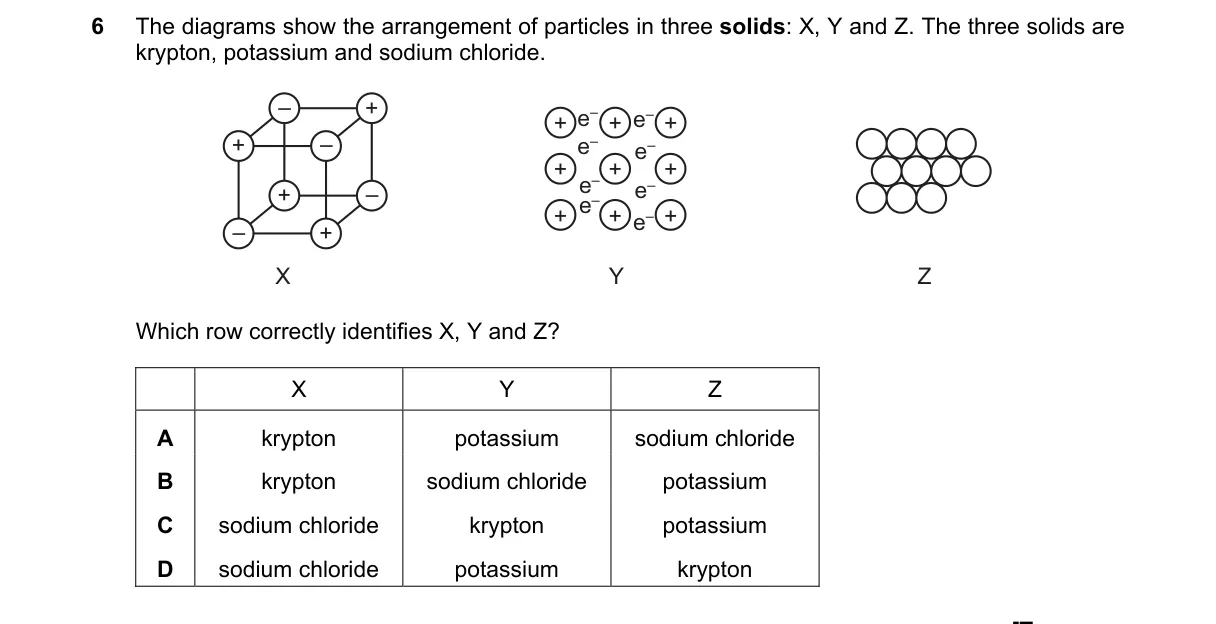
Answer choices
- AX krypton Y potassium Z sodium chloride
- BX sodium chloride Y krypton Z potassium
- CX potassium Y sodium chloride Z krypton
- DX sodium chloride Y potassium Z krypton
Explanation
Identifying solids by particle lattice structures
Steps:
- Examine diagrams: X shows alternating positive/negative ions (ionic lattice), Y shows uniform positive ions in electron sea (metallic lattice), Z shows identical atoms in lattice (atomic solid).
- Recall structures: Sodium chloride (NaCl) is ionic with Na⁺ and Cl⁻ ions; potassium (K) is metallic with K⁺ ions delocalized electrons; krypton (Kr) is atomic solid of monatomic noble gas.
- Match X to NaCl (ionic), Y to K (metallic), Z to Kr (atomic).
- Select option aligning with these matches.
Why D is correct:
- D assigns X as NaCl (ionic lattice of ions), Y as potassium (metallic lattice), Z as krypton (atomic lattice), matching definitions of each solid's bonding.
Why the others are wrong:
- A misassigns X as krypton (atomic, not ionic) and Y as potassium (ignores metallic traits).
- B misassigns X as NaCl (correct) but swaps Y and Z, confusing metallic with atomic.
- C misassigns X as potassium (metallic, not ionic) and Z as krypton (correct but overall mismatch).
Final answer: D
Topic: Solids, liquids and gases
Practice more O Levels/IGCSE Chemistry (5070) questions on mMCQ.me