O Levels/IGCSE Chemistry (5070)•5070/12/M/J/18
O Levels/IGCSE Chemistry (5070) — 5070/12/M/J/18, Question 4
Two gases, ammonia and hydrogen chloride, at equal pressure, are allowed to enter the apparatus shown. After a time, a white solid forms on the inside of the tube. Which statements explain why a white solid forms in the position shown? 1 Ammonia diffuses faster than hydrogen chloride. 2 Ammonia has a lower molecular mass than hydrogen chloride. 3 Ammonia has a lower molecular mass than hydrogen chloride.
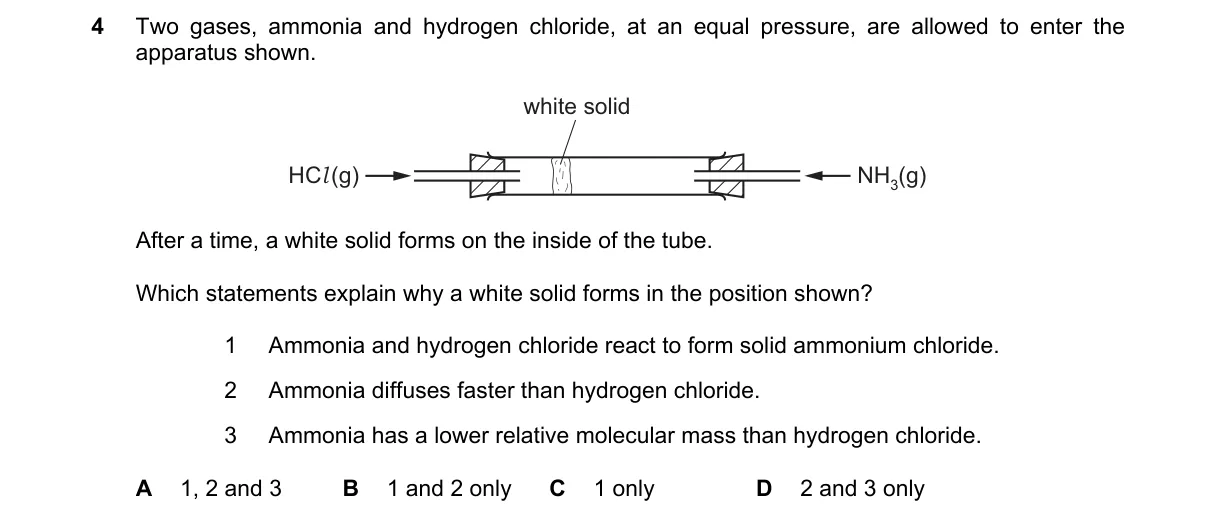
Answer choices
- A1,2 and 3
- B1 and 2 only
- C1 only
- D2 and 3 only
Explanation
Graham's Law of Diffusion
Steps:
- Ammonia (NH₃, molar mass 17 g/mol) and hydrogen chloride (HCl, molar mass 36.5 g/mol) start at equal pressure from opposite ends.
- Lighter NH₃ diffuses faster than heavier HCl, per Graham's law: rate ∝ 1/√molar mass.
- NH₃ travels farther, so they meet closer to HCl end, forming white NH₄Cl solid there.
- Statements 1, 2, and 3 all explain this: faster diffusion and lower mass of NH₃.
Why A is correct:
- Includes all true statements; identical 2 and 3 both state NH₃'s lower molar mass, directly causing faster diffusion (Graham's law).
Why the others are wrong:
- B omits statement 3, which is valid.
- C ignores mass statements, missing root cause.
- D excludes statement 1, ignoring diffusion rate observation.
Final answer: A
Topic: Diffusion
Practice more O Levels/IGCSE Chemistry (5070) questions on mMCQ.me