O Levels/IGCSE Chemistry (5070)•5070/12/M/J/18
O Levels/IGCSE Chemistry (5070) — 5070/12/M/J/18, Question 31
The diagram shows a cell that can be used to extract a metal from its oxide. Molten aluminium oxide, copper(II) oxide, lead(II) oxide and magnesium oxide are each electrolysed in separate cells. Each cell receives the same number of electrons. Which statement is correct?
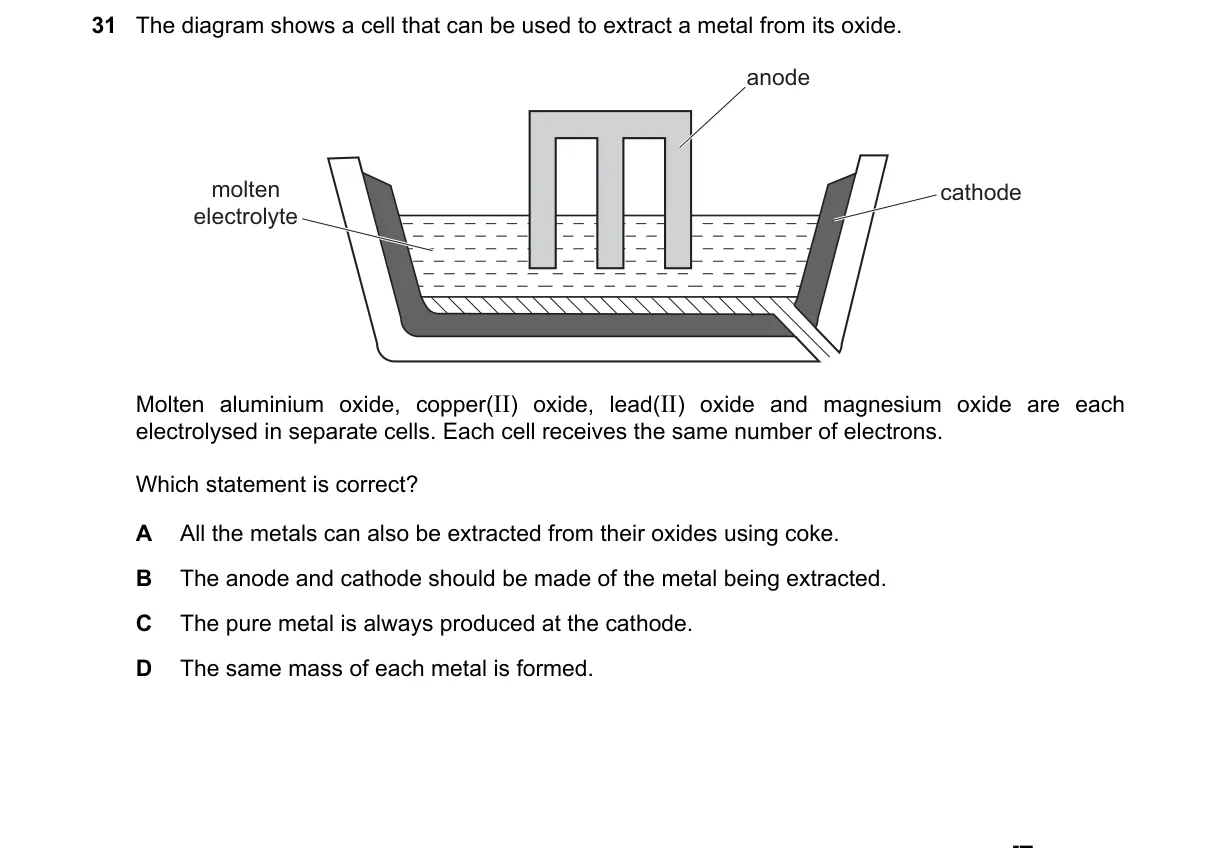
Answer choices
- AAll the metals can also be extracted from their ores using coke.
- BThe pure metal is always produced at the cathode.
- CThe same mass of each metal is formed.
- DThe anode and cathode should be made of the metal being extracted.
Explanation
Electrolysis of molten metal oxides deposits pure metal at the cathode Steps:
- Identify cathode reaction: metal ions (Al³⁺, Cu²⁺, Pb²⁺, Mg²⁺) gain electrons to form neutral metal atoms.
- Confirm for all oxides: molten state ensures no water, so only metal ions reduce at cathode, yielding pure metal.
- Evaluate options: A fails for reactive metals, C ignores varying equivalent weights, D uses inert electrodes.
Why B is correct:
- Faraday's laws define cathode as reduction site; in molten oxides, Mⁿ⁺ + n e⁻ → M produces pure metal without impurities.
Why the others are wrong:
- A: Aluminium and magnesium oxides are too stable for carbon reduction with coke; require electrolysis.
- C: Mass m = (M/n) × (Q/F); different atomic masses M and valencies n yield different masses for same charge Q.
- D: Inert electrodes (e.g., graphite) prevent anode dissolution; metal electrodes would react undesirably.
Final answer: B
Topic: Electrolysis
Practice more O Levels/IGCSE Chemistry (5070) questions on mMCQ.me