O Levels/IGCSE Chemistry (5070)•5070/12/M/J/18
O Levels/IGCSE Chemistry (5070) — 5070/12/M/J/18, Question 14
Magnesium can be produced by electrolysis of molten magnesium chloride, MgCl₂. What are the products formed at the anode and the cathode during the electrolysis of molten magnesium chloride?
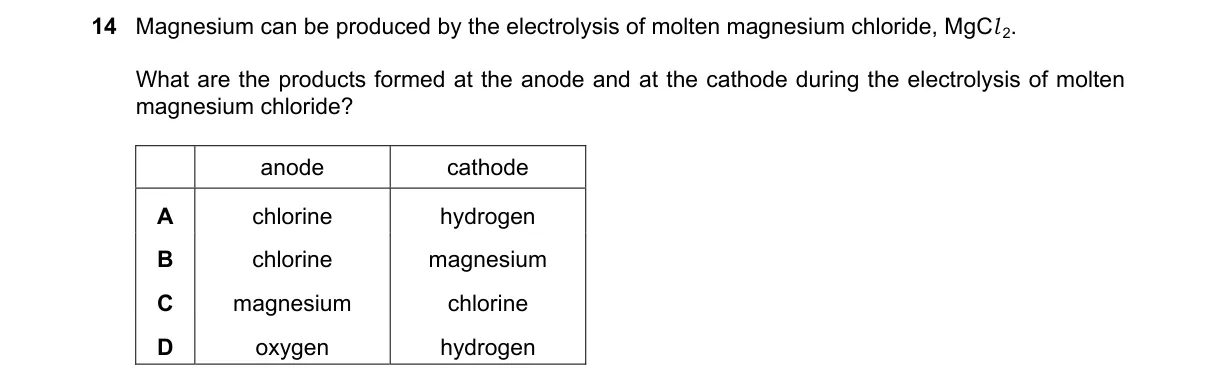
Answer choices
- Aanode: chlorine, cathode: magnesium
- Banode: chlorine, cathode: hydrogen
- Canode: magnesium, cathode: chlorine
- Danode: oxygen, cathode: hydrogen
Explanation
Electrolysis of molten salts produces metal at cathode and non-metal at anode
Steps:
- Identify ions in molten MgCl₂: Mg²⁺ cations and Cl⁻ anions.
- At cathode (negative electrode), cations gain electrons: Mg²⁺ + 2e⁻ → Mg (magnesium metal).
- At anode (positive electrode), anions lose electrons: 2Cl⁻ → Cl₂ + 2e⁻ (chlorine gas).
- No water present in molten state, so no hydrogen or oxygen formed.
Why A is correct:
- Follows reduction of cation to metal at cathode and oxidation of anion to halogen at anode, per Faraday's laws of electrolysis.
Why the others are wrong:
- B: Hydrogen forms in aqueous electrolysis (e.g., with water), not molten.
- C: Reverses electrode products; magnesium is not oxidized at anode.
- D: Oxygen and hydrogen indicate aqueous solution electrolysis, not molten salt.
Final answer: A
Topic: Electrolysis
Practice more O Levels/IGCSE Chemistry (5070) questions on mMCQ.me