O Levels/IGCSE Chemistry (5070)•5070/11/M/J/18
O Levels/IGCSE Chemistry (5070) — 5070/11/M/J/18, Question 8
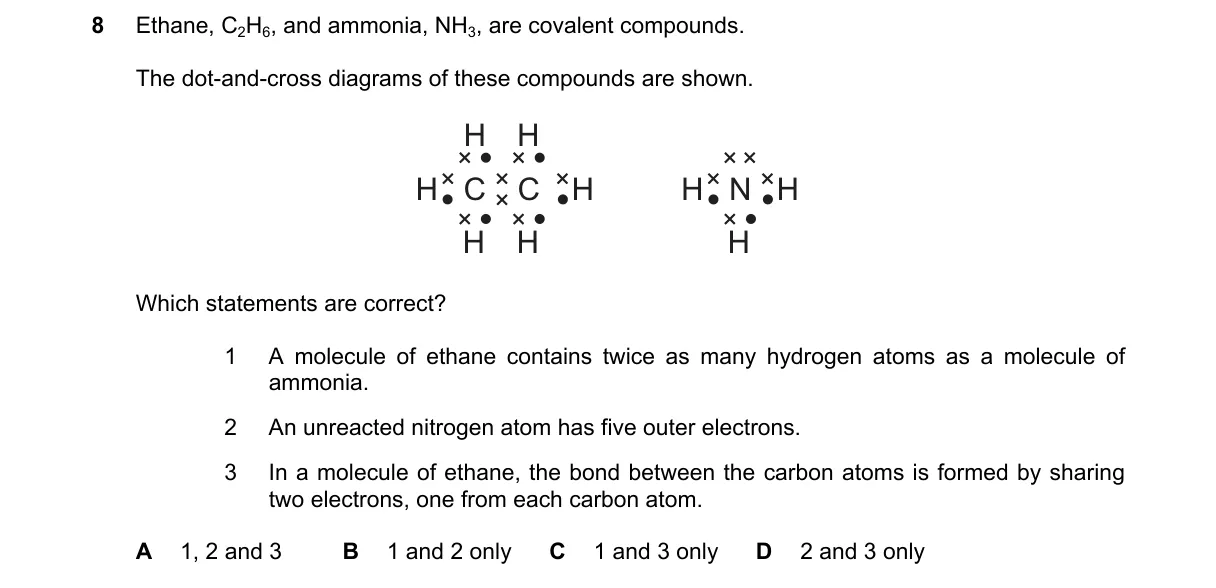
Ethane, CH4, and ammonia, NH3, are covalent compounds. The dot-and-cross diagrams of these compounds are shown. Which statements are correct 1. A molecule of ethane contains twice as many hydrogen atoms as a molecule of ammonia. 2. An unreacted nitrogen atom has five electrons. 3. In a molecule of ethane, the bond between the carbon atoms is formed by sharing
Answer choices
- A1,2 and 3
- B1 and 2 only
- C1 and 3 only
- D2 and 3 only
Explanation
Verifying statements on ethane and ammonia structures
Steps:
- Statement 1: Ethane formula is C₂H₆ (not CH₄, likely a typo), with 6 H atoms; ammonia NH₃ has 3 H atoms, so ethane has twice as many.
- Statement 2: Nitrogen (atomic number 7) has 7 total electrons, with 5 valence electrons in its outer shell for unreacted atom.
- Statement 3: Ethane's C–C bond is covalent, formed by sharing two electrons between carbon atoms.
- All statements hold true, selecting option A.
Why A is correct:
- A includes all three valid statements based on molecular formulas and covalent bonding principles.
Why the others are wrong:
- B omits statement 3, which correctly describes covalent sharing.
- C omits statement 2, which accurately states nitrogen's valence electrons.
- D omits statement 1, which matches the hydrogen atom ratio in ethane (C₂H₆) and ammonia.
Final answer: A
Topic: Simple molecules and covalent bonds
Practice more O Levels/IGCSE Chemistry (5070) questions on mMCQ.me