O Levels/IGCSE Chemistry (5070)•5070/11/M/J/18
O Levels/IGCSE Chemistry (5070) — 5070/11/M/J/18, Question 33
Aluminium is a Group element. It is extracted from its ore by electrolysis. The position of aluminium in the Periodic Table indicates that its aqueous ion is likely to be [1]. The method of extraction indicates that aluminium [2] in the reactivity series. Which words complete gaps 1 and 2?
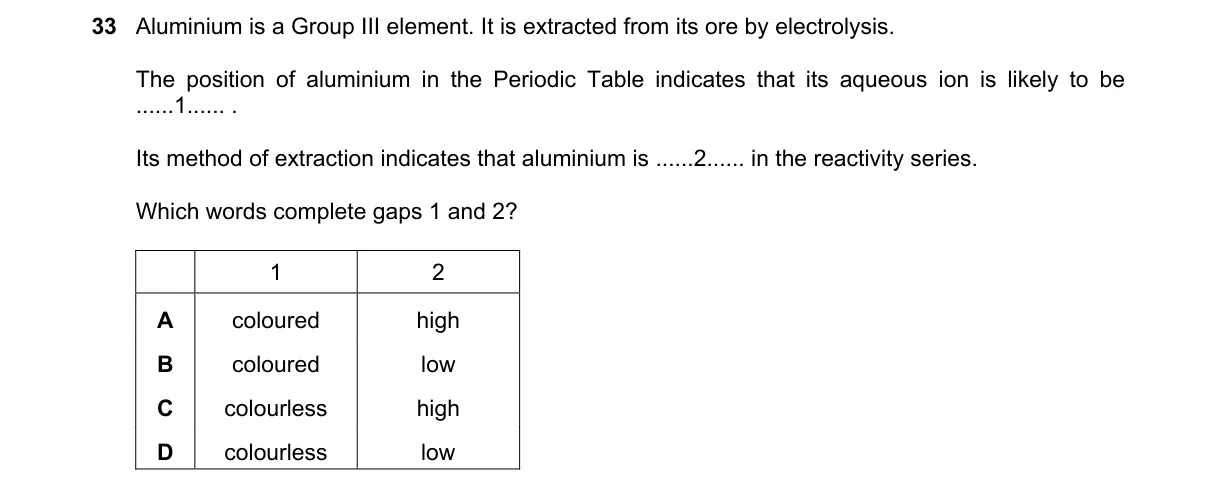
Answer choices
- Acoloured, high
- Bcoloured, low
- Ccolourless, high
- Dcolourless, low
Explanation
Aluminium ion properties and reactivity
Steps:
- Aluminium is in Group 13 (p-block), not a transition metal, so its Al³⁺ ion has no d-electrons and is colourless in aqueous solution.
- Transition metal ions are coloured due to d-d transitions, but main group ions like Al³⁺ are not.
- Electrolysis extracts aluminium because it is too reactive to be reduced by carbon, placing it high in the reactivity series (above magnesium).
- Thus, gaps are filled by "colourless" for [1] and "high" for [2].
Why C is correct:
- Al³⁺ ions are colourless as they lack unpaired d-electrons for light absorption (definition of ion color in coordination chemistry); electrolysis confirms high reactivity per the reactivity series law.
Why the others are wrong:
- A: Aluminium ions are colourless, not coloured.
- B: Aluminium is high, not low, in reactivity.
- D: Aluminium is high, not low, in reactivity.
Final answer: C
Topic: Extraction of metals
Practice more O Levels/IGCSE Chemistry (5070) questions on mMCQ.me