O Levels/IGCSE Chemistry (5070)•5070/11/M/J/18
O Levels/IGCSE Chemistry (5070) — 5070/11/M/J/18, Question 3
Tests were carried out on an aqueous solution of unknown compound, P. The observations are recorded in the table. dilute sodium hydroxide added: green precipitate, soluble in excess giving a green solution; then dilute nitric acid added: no precipitate; aqueous barium nitrate: white precipitate; aqueous silver nitrate: no precipitate. Which ions are present in P?
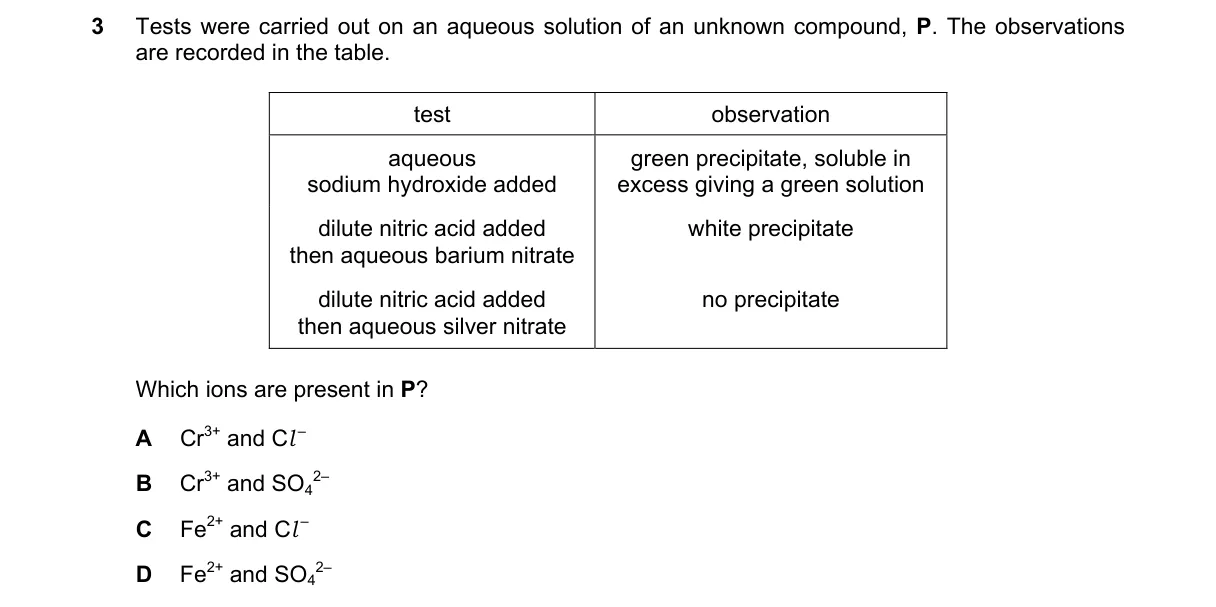
Answer choices
- ACr^{3+} and Cl^{-}
- BFe^{3+} and Cl^{-}
- CFe^{2+} and SO_{4}^{2-}
- DFe^{3+} and SO_{4}^{2-}
Explanation
Qualitative tests identify Fe²⁺ and SO₄²⁻ ions Steps:
- Green precipitate with dilute NaOH, soluble in excess to green solution, points to Fe²⁺ forming Fe(OH)₂.
- No precipitate on adding dilute HNO₃ to the green solution confirms non-amphoteric behavior, ruling out Cr³⁺.
- White precipitate with aqueous Ba(NO₃)₂ indicates SO₄²⁻ forming insoluble BaSO₄.
- No precipitate with aqueous AgNO₃ confirms absence of halides like Cl⁻.
Why C is correct:
- Fe²⁺ produces dirty green Fe(OH)₂ precipitate with NaOH (often appearing as green suspension in excess); SO₄²⁻ forms white BaSO₄ with Ba²⁺ but no precipitate with Ag⁺, per solubility rules.
Why the others are wrong:
- A. Cr³⁺ forms green Cr(OH)₃ soluble in excess NaOH, but HNO₃ reprecipitates it; Cl⁻ forms white AgCl.
- B. Fe³⁺ forms brown Fe(OH)₃ insoluble in excess NaOH; Cl⁻ forms AgCl but no BaSO₄.
- D. Fe³⁺ forms brown Fe(OH)₃ insoluble in excess NaOH, not green.
Final answer: C
Topic: Identification of ions and gases
Practice more O Levels/IGCSE Chemistry (5070) questions on mMCQ.me