O Levels/IGCSE Chemistry (5070)•5070/11/M/J/18
O Levels/IGCSE Chemistry (5070) — 5070/11/M/J/18, Question 23
Pure lead(II) sulfate is prepared by mixing two substances, X and Y. When the reaction is complete the mixture is filtered. Pure lead(II) sulfate is obtained. Which row shows the best way to prepare pure lead(II) sulfate?
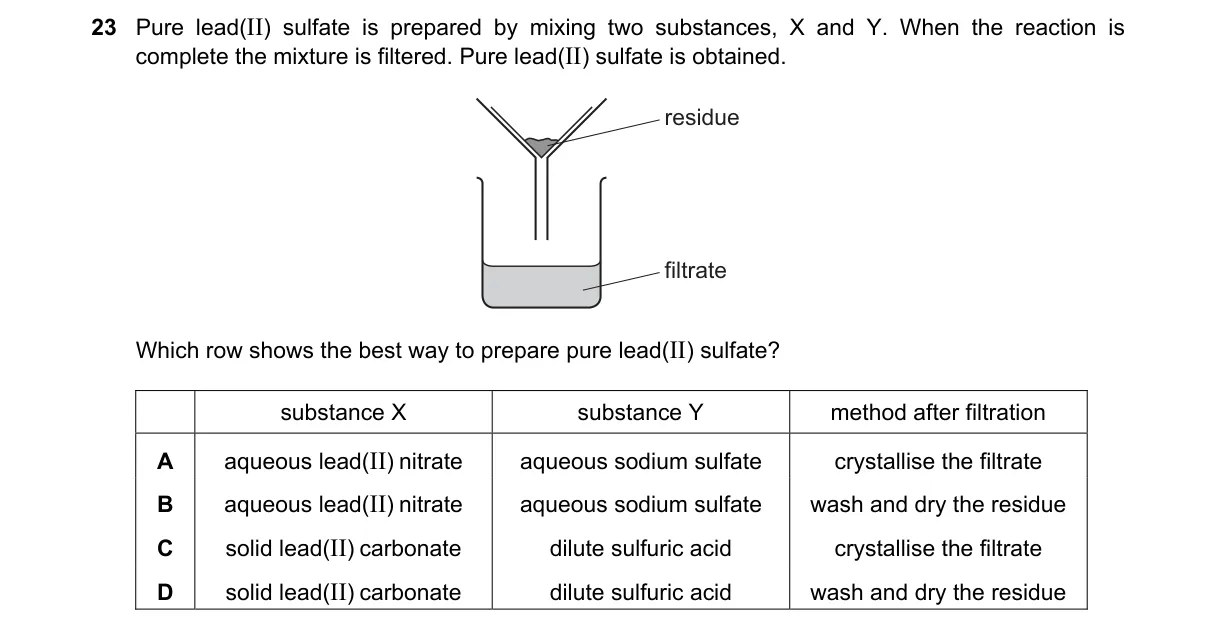
Answer choices
- Aaqueous lead(II) nitrate, aqueous sodium sulfate, crystallise the filtrate
- Bsolid lead(II) carbonate, aqueous sodium sulfate, wash and dry the residue
- Csolid lead(II) nitrate, dilute sulfuric acid, crystallise the filtrate
- Dsolid lead(II) carbonate, dilute sulfuric acid, wash and dry the residue
Explanation
Precipitation of insoluble lead(II) sulfate via double displacement Steps:
- React solid lead(II) carbonate with aqueous sodium sulfate to form insoluble PbSO4 precipitate and soluble Na2CO3.
- Filter the mixture to separate the solid PbSO4 residue from the aqueous filtrate.
- Wash the residue with water to remove impurities like excess sodium sulfate.
- Dry the washed residue to obtain pure solid lead(II) sulfate.
Why B is correct:
- PbCO3(s) + Na2SO4(aq) → PbSO4(s) + Na2CO3(aq); insoluble PbSO4 precipitates and is isolated by washing/drying the residue, yielding pure solid without soluble byproducts contaminating it.
Why the others are wrong:
- A: Crystallizing the filtrate recovers soluble NaNO3, not insoluble PbSO4 residue.
- C: Solid Pb(NO3)2 dissolves in H2SO4 to form PbSO4(s), but crystallizing filtrate yields HNO3, not PbSO4.
- D: H2SO4 reacts with PbCO3 to evolve CO2 gas, risking incomplete reaction or impure residue without specified neutralization.
Final answer: B
Topic: Preparation of salts
Practice more O Levels/IGCSE Chemistry (5070) questions on mMCQ.me