O Levels/IGCSE Chemistry (5070)•5070/11/M/J/18
O Levels/IGCSE Chemistry (5070) — 5070/11/M/J/18, Question 21
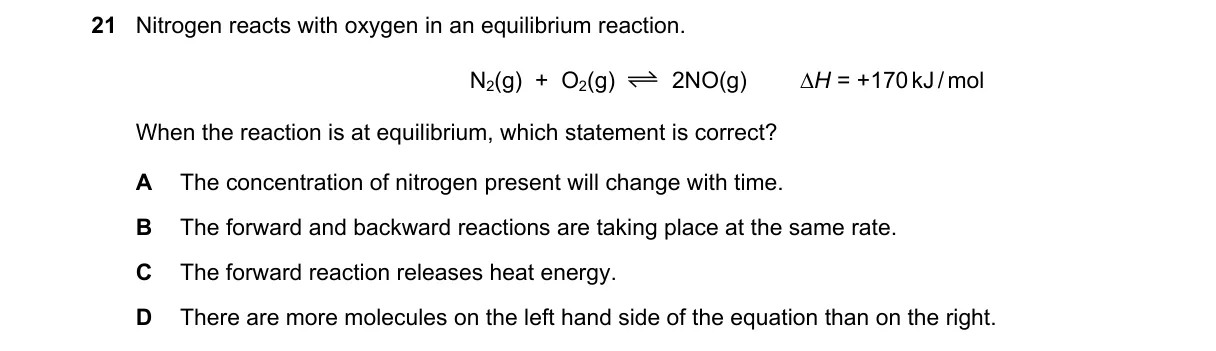
Nitrogen reacts with oxygen in an equilibrium reaction. N₂(g) + O₂(g) ⇌ 2NO(g) ΔH = +170 kJ/mol When the reaction is at equilibrium, which statement is correct?
Answer choices
- AThe concentration of nitrogen present will change with time.
- BThe forward and backward reactions are taking place at the same rate.
- CThe forward reaction releases heat energy.
- DThere are more molecules on the left side of the equation than right.
Explanation
Chemical Equilibrium Definition
Steps:
- Examine the reaction at equilibrium: forward and reverse processes occur but net change is zero.
- Apply equilibrium principle: concentrations stabilize when reaction rates balance.
- Evaluate options against rate equality and reaction properties.
- Confirm B matches the core equilibrium condition.
Why B is correct:
- Dynamic equilibrium requires forward and reverse rates to be equal, per Le Châtelier's principle and rate law definitions.
Why the others are wrong:
- A: Equilibrium concentrations do not change with time; they remain constant.
- C: Positive ΔH (+170 kJ/mol) means forward reaction is endothermic, absorbing heat.
- D: Both sides have two molecules (N₂ + O₂ = 2; 2NO = 2), so equal.
Final answer: B
Topic: Reversible reactions and equilibrium
Practice more O Levels/IGCSE Chemistry (5070) questions on mMCQ.me