O Levels/IGCSE Chemistry (5070)•5070/11/M/J/18
O Levels/IGCSE Chemistry (5070) — 5070/11/M/J/18, Question 19
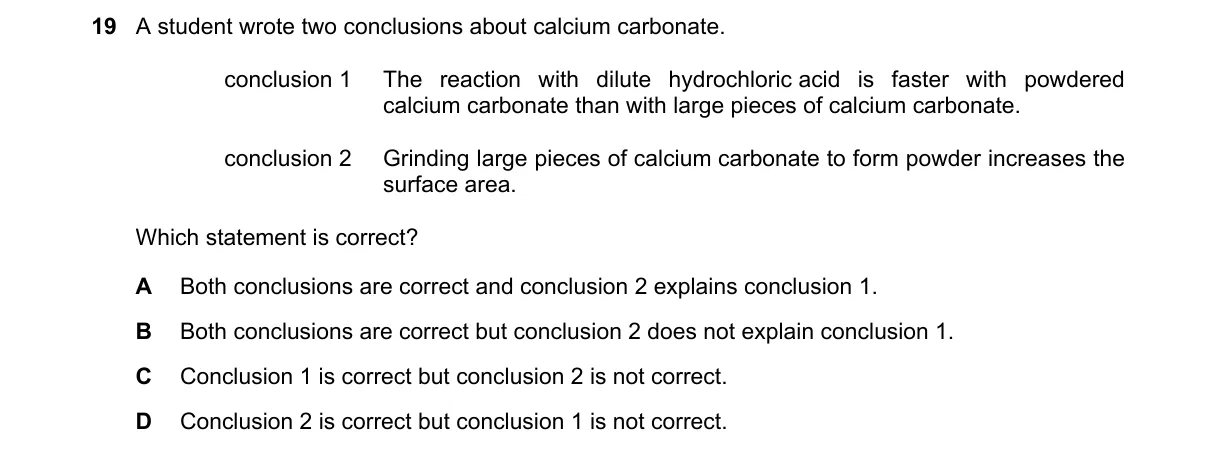
A student wrote two conclusions about calcium carbonate. Conclusion 1 The reaction with dilute hydrochloric acid is faster with powdered calcium carbonate than with large pieces of calcium carbonate. Conclusion 2 Grinding calcium carbonate to form powder increases the surface area.
Answer choices
- ABoth conclusions are correct and conclusion 2 explains conclusion 1.
- BBoth conclusions are correct but conclusion 2 does not explain conclusion 1.
- CConclusion 1 is correct but conclusion 2 is not.
- DConclusion 2 is correct but conclusion 1 is not.
Explanation
Surface Area's Role in Reaction Rates
Steps:
- Conclusion 1 states powdered calcium carbonate reacts faster with HCl than large pieces, which aligns with increased exposure for collisions.
- Conclusion 2 states grinding increases surface area, a direct physical effect of particle size reduction.
- Increased surface area from powdering allows more reactant molecules to collide with the solid, explaining the faster rate in conclusion 1.
- Both conclusions are factually correct, with 2 providing the mechanistic explanation for 1.
Why A is correct:
- Per collision theory, reaction rate in heterogeneous reactions increases with surface area, as more sites enable frequent effective collisions.
Why the others are wrong:
- B: Incorrect, as increased surface area directly causes the faster reaction rate.
- C: Incorrect, as grinding objectively increases surface area by exposing more material.
- D: Incorrect, as powdered form reacts faster due to greater surface exposure.
Final answer: A
Topic: Rate of reaction
Practice more O Levels/IGCSE Chemistry (5070) questions on mMCQ.me