O Levels/IGCSE Chemistry (5070)•5070/11/M/J/18
O Levels/IGCSE Chemistry (5070) — 5070/11/M/J/18, Question 15
The diagram shows apparatus that can be used to extract aluminium from its ore. What are J, K and L?
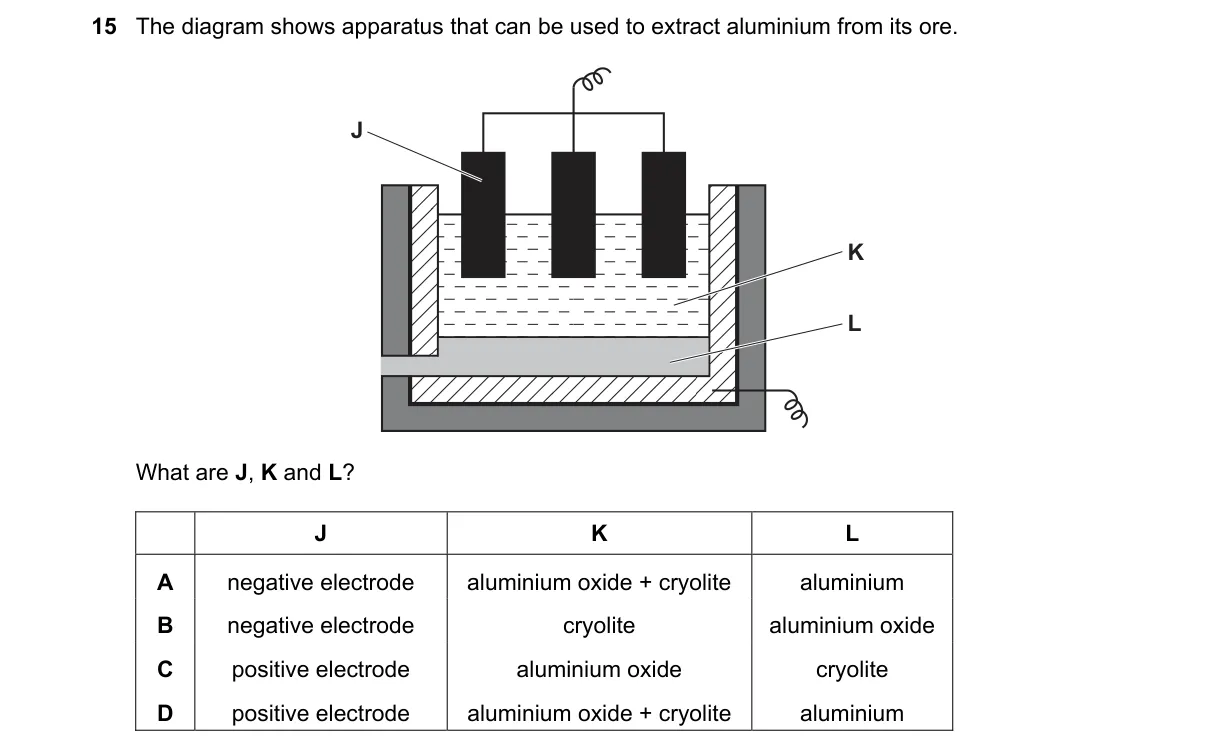
Answer choices
- AJ: negative electrode, K: aluminium oxide + cryolite, L: aluminium
- BJ: positive electrode, K: cryolite, L: aluminium oxide
- CJ: positive electrode, K: aluminium oxide + cryolite, L: aluminium
- DJ: positive electrode, K: aluminium + cryolite, L: aluminium oxide
Explanation
Hall-Héroult Process for Aluminum Extraction Steps:
- Identify the electrolysis setup: molten aluminum oxide (Al₂O₃) is dissolved in cryolite (Na₃AlF₆) to lower the melting point.
- The positive electrode (anode) is carbon, where oxygen forms CO₂.
- The electrolyte mixture is Al₂O₃ + cryolite, enabling conduction at lower temperatures.
- Aluminum metal deposits at the negative electrode (cathode) and is collected as L.
Why C is correct:
- Matches the process: anode (J, positive) oxidizes oxygen; electrolyte (K, Al₂O₃ + cryolite) dissolves the ore; product (L, aluminum) forms at cathode.
Why the others are wrong:
- A: J is anode (positive), not negative; aluminum forms at negative electrode.
- B: K includes Al₂O₃ with cryolite, not cryolite alone; L is product aluminum, not Al₂O₃.
- D: K is electrolyte (Al₂O₃ + cryolite), not aluminum + cryolite; L is aluminum, not Al₂O₃.
Final answer: C
Topic: Extraction of metals
Practice more O Levels/IGCSE Chemistry (5070) questions on mMCQ.me