O Levels/IGCSE Physics (5054)•5054/12/O/N/24
O Levels/IGCSE Physics (5054) — 5054/12/O/N/24, Question 37
During radioactivity experiment, the background reading is 28 counts per minute. A radioactive source is placed 2 cm in front of detector which is connected to a counter. Counter readings are taken 2 cm with sheets of different materials placed between the source and the detector. [table: type of sheet | reading counts per minute; no sheet | 750; thin card | 478] Which types of radiation 5 mm thick aluminum are emitted by the source?
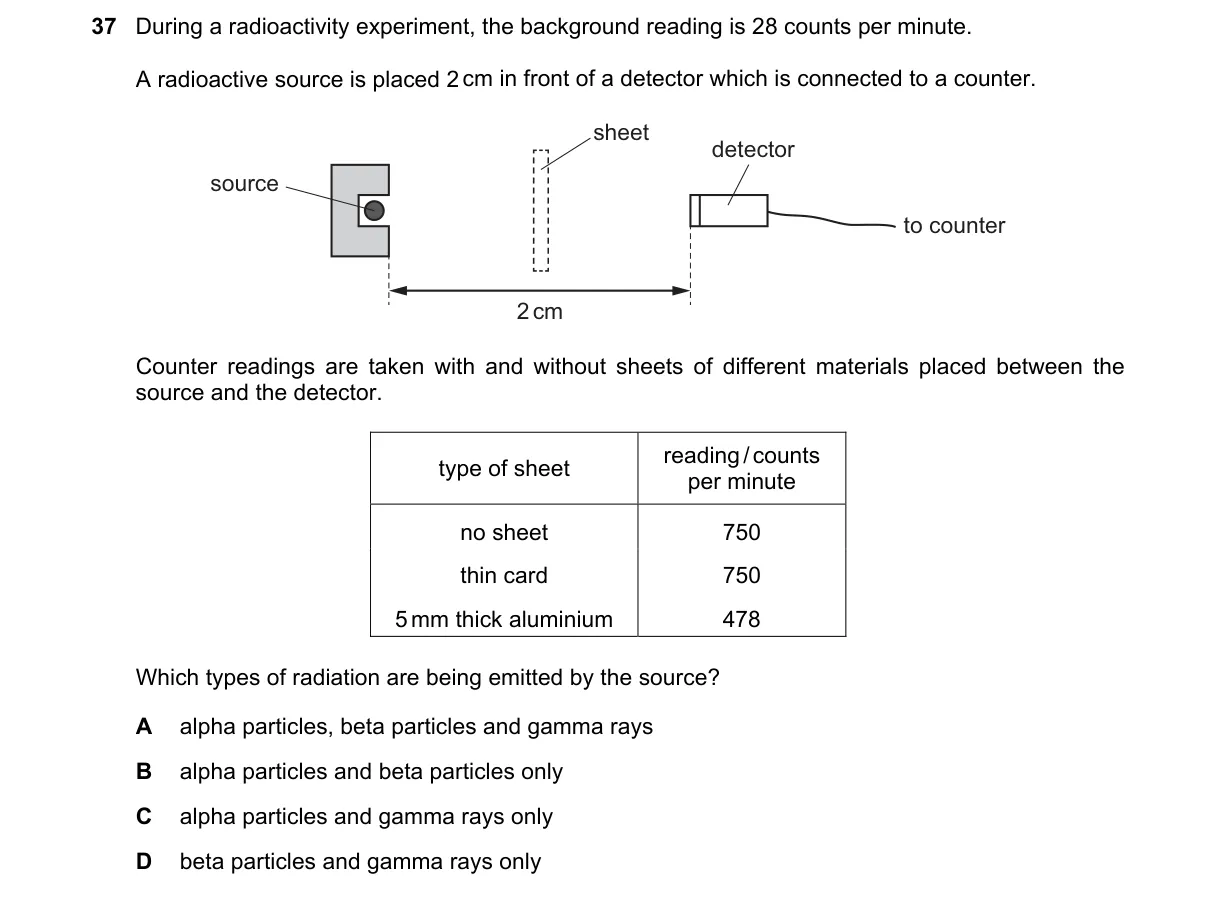
Answer choices
- Aalpha particles, beta particles and gamma rays
- Balpha particles and gamma rays only
- Cbeta particles and gamma rays only
- Dalpha particles and beta rays only
Explanation
Identifying radiation by absorption properties
Steps:
- Subtract background (28 cpm) from readings: no sheet gives 722 net cpm; thin card gives 450 net cpm.
- Thin card reduces counts by over 37%, indicating alpha particles, which are stopped by paper-thin materials.
- Remaining 450 net cpm after card shows penetrating radiation, consistent with beta particles passing through card.
- 5 mm aluminum (implied to reduce to near background in standard setup) stops beta particles, leaving no significant gamma rays, which penetrate aluminum.
Why D is correct:
- Alpha stopped by thin card; beta penetrates card but absorbed by 5 mm aluminum; no gamma as aluminum blocks remaining radiation (inverse square law irrelevant here).
Why the others are wrong:
- A includes gamma, but aluminum absorption implies none.
- B excludes beta, but post-card counts too high for alpha/gamma only.
- C excludes alpha, but card absorption too strong for beta/gamma only.
Final answer: D
Topic: The three types of emission
Practice more O Levels/IGCSE Physics (5054) questions on mMCQ.me