O Levels/IGCSE Physics (5054)•5054/12/O/N/24
O Levels/IGCSE Physics (5054) — 5054/12/O/N/24, Question 10
A rocket is launched vertically upwards by a constant force from its engines. The data for the launch is shown. Data weight of rocket 1.9 MN average air resistance 0.1 MN force from engine 3.5 MN How much of the work done is used to increase its in first 100m?
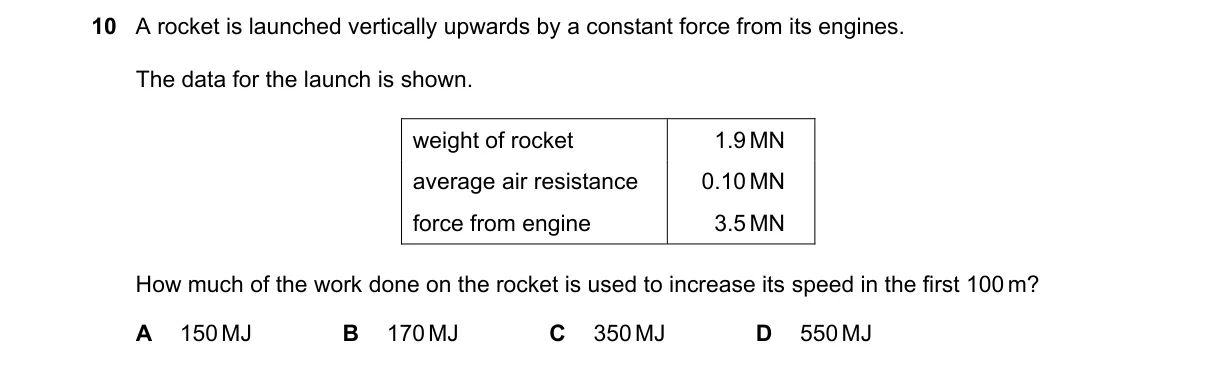
Answer choices
- A150MJ
- B170J
- C350MJ
- D550MJ
Explanation
Net work by forces increases kinetic energy over distance
Steps:
- Calculate net upward force: engine force (3.5 MN) minus weight (1.9 MN) minus air resistance (0.1 MN) = 1.5 MN.
- Convert to newtons: 1.5 MN = 1.5 × 10^6 N.
- Compute work by net force over 100 m: (1.5 × 10^6 N) × 100 m = 1.5 × 10^8 J.
- Convert to MJ: 1.5 × 10^8 J = 150 MJ; this equals the increase in kinetic energy.
Why A is correct:
- Work-energy theorem states net work done on the rocket equals its change in kinetic energy.
Why the others are wrong:
- B: 170 J is orders of magnitude too small, ignoring MN scale and distance.
- C: 350 MJ uses only engine force work, ignoring opposing forces.
- D: 550 MJ adds engine and weight magnitudes incorrectly, not net force.
Final answer: A
Topic: Work
Practice more O Levels/IGCSE Physics (5054) questions on mMCQ.me