O Levels/IGCSE Physics (5054)•5054/11/O/N/24
O Levels/IGCSE Physics (5054) — 5054/11/O/N/24, Question 40
A student spills ink on the page in a textbook that defines redshift. The ink covers the three important words 1, 2, and 3. Redshift is the ... in the observed ... of electromagnetic radiation emitted from ... stars and galaxies observed. What are words 1, 2, and 3?
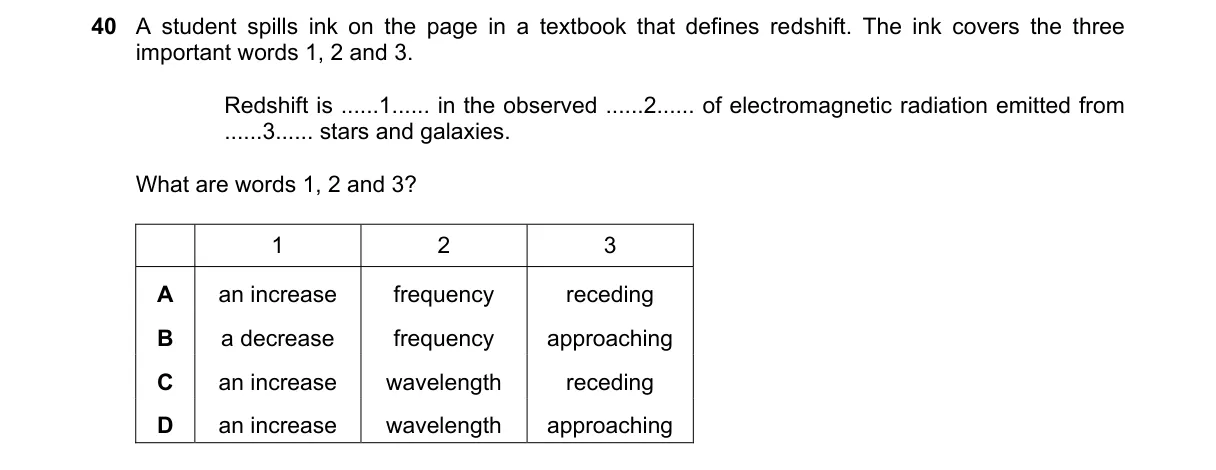
Answer choices
- Aan increase frequency receding
- Ba decrease frequency approaching
- Can increase wavelength approaching
- Dan increase wavelength receding
Explanation
Redshift as Doppler Effect in Astronomy
Steps:
- Recall redshift: phenomenon where light from distant objects stretches to longer wavelengths due to expansion or motion.
- Identify blanks: Word 1 describes change (increase/decrease), word 2 is property (wavelength/frequency), word 3 is motion (receding/approaching).
- Match to sentence: Redshift means "increase in the observed wavelength of electromagnetic radiation emitted from receding stars and galaxies."
- Confirm with Doppler principle: Receding sources cause wavelength increase (redshift), approaching cause decrease (blueshift).
Why C is correct:
- Redshift is defined as the increase in observed wavelength (λ_observed > λ_emitted) for light from receding sources, per the relativistic Doppler formula: z = (λ_observed - λ_emitted)/λ_emitted > 0.
Why the others are wrong:
- A: Increase in frequency indicates blueshift for approaching sources, opposite of redshift.
- B: Decrease in frequency for approaching sources describes blueshift, not redshift.
- D: Increase in wavelength for approaching sources would be blueshift, contradicting redshift's receding motion.
Final answer: C
Topic: The Sun as a star
Practice more O Levels/IGCSE Physics (5054) questions on mMCQ.me