O Levels/IGCSE Physics (5054)•5054/11/O/N/24
O Levels/IGCSE Physics (5054) — 5054/11/O/N/24, Question 28
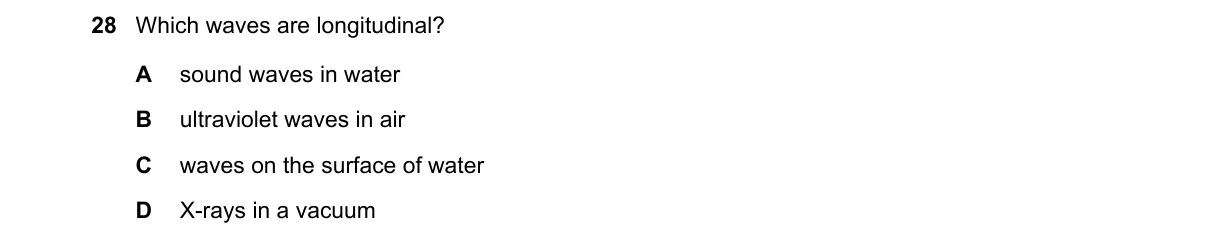
Which waves are longitudinal?
Answer choices
- Asound waves in water
- Bultraviolet waves in air
- Cwaves on the surface of water
- DX-rays in vacuum
Explanation
Longitudinal waves involve particle vibration parallel to propagation direction
Steps:
- Define longitudinal waves: oscillations where medium particles move parallel to wave travel.
- Identify sound waves: compressions and rarefactions cause parallel particle motion.
- Contrast with transverse waves: perpendicular particle motion, common in electromagnetic and surface waves.
- Evaluate options against definitions to select the match.
Why A is correct:
- Sound waves propagate via alternating high- and low-pressure regions, with water particles displacing parallel to the wave direction, per the definition of longitudinal waves.
Why the others are wrong:
- B: Ultraviolet waves are electromagnetic, with electric/magnetic fields oscillating perpendicular to propagation (transverse).
- C: Surface water waves involve particles moving in circles or ellipses perpendicular to the main propagation (transverse).
- D: X-rays are electromagnetic radiation, propagating transversely in vacuum without medium particle involvement.
Final answer: A
Topic: General properties of waves
Practice more O Levels/IGCSE Physics (5054) questions on mMCQ.me