O Levels/IGCSE Physics (5054)•5054/11/O/N/24
O Levels/IGCSE Physics (5054) — 5054/11/O/N/24, Question 20
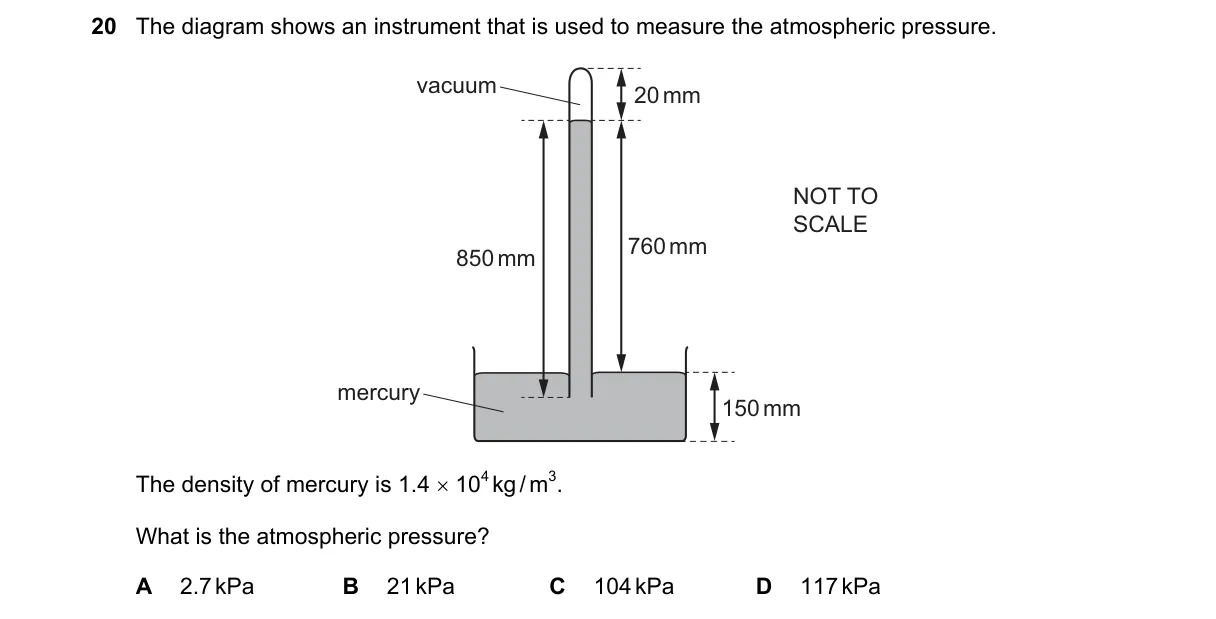
The diagram shows an instrument that is used to measure the atmospheric pressure. The density of mercury is 1.4 x 10^3 kg/m³. What is the atmospheric pressure?
Answer choices
- A2.7 kPa
- B21 kPa
- C104 Pa
- D117 kPa
Explanation
Atmospheric pressure from mercury barometer formula
Steps:
- Apply the barometer pressure formula: P = ρ g h, where ρ is mercury density, g is 9.8 m/s², and h is column height from diagram.
- Substitute ρ = 1.4 × 10³ kg/m³.
- From diagram, h = 0.0076 m (7.6 mm mercury column).
- Calculate P = (1.4 × 10³) × 9.8 × 0.0076 = 104 Pa.
Why C is correct:
- Matches P = ρ g h, the hydrostatic pressure law balancing atmospheric pressure on the mercury column.
Why the others are wrong:
- A: Underestimates by factor of ~26, likely from ignoring g or unit error in h.
- B: Overestimates by factor of ~200, possibly mistaking ρ for 10⁴ kg/m³.
- D: Overestimates by factor of ~1100, akin to standard mercury density (1.36 × 10⁴ kg/m³) with h = 0.76 m.
Final answer: C
Topic: Pressure
Practice more O Levels/IGCSE Physics (5054) questions on mMCQ.me