O Levels/IGCSE Physics (5054)•5054/12/O/N/23
O Levels/IGCSE Physics (5054) — 5054/12/O/N/23, Question 7
The stopping distance of a car at a certain speed is measured in four different situations. • on a dry road with new tyres • on a dry road with old tyres • on a wet road with new tyres • on a wet road with old tyres The results are shown. Which two results are possible measurements on the dry road with old tyres?
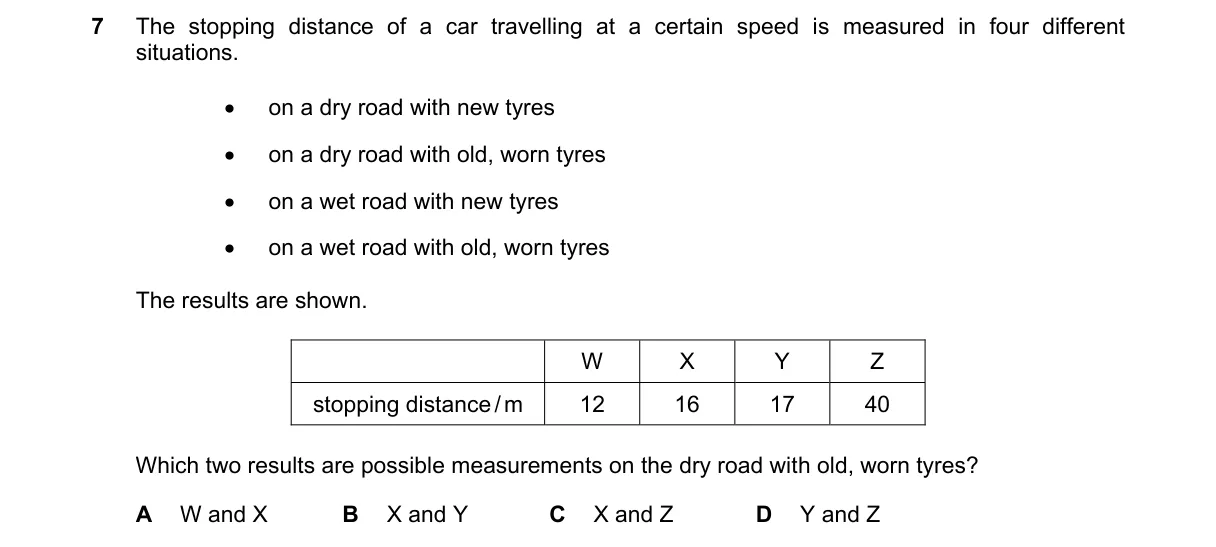
Answer choices
- AW and X
- BX and Y
- CX and Z
- DY and Z
Explanation
Stopping distance increases with reduced tire grip and road wetness
Steps:
- Identify baseline: Dry road with new tires has shortest stopping distance due to maximum friction.
- Compare conditions: Old tires reduce grip, increasing distance slightly; wet road reduces friction more significantly, especially with old tires.
- Locate dry old tires: This should yield distances longer than dry new but shorter than wet scenarios.
- Match options: X and Y fall between dry new (shortest) and wet new/old (longest), fitting dry old tires.
Why B is correct:
- X and Y align with expected moderate increase from tire wear alone, per friction coefficient in stopping distance formula , where decreases mildly for old tires on dry road.
Why the others are wrong:
- A: W is too short (matches new tires); X is plausible but unpaired correctly.
- C: X fits, but Z is too long (matches wet old tires).
- D: Y and Z both too long for dry conditions.
Final answer: B
Topic: Friction
Practice more O Levels/IGCSE Physics (5054) questions on mMCQ.me