O Levels/IGCSE Physics (5054)•5054/12/O/N/23
O Levels/IGCSE Physics (5054) — 5054/12/O/N/23, Question 18
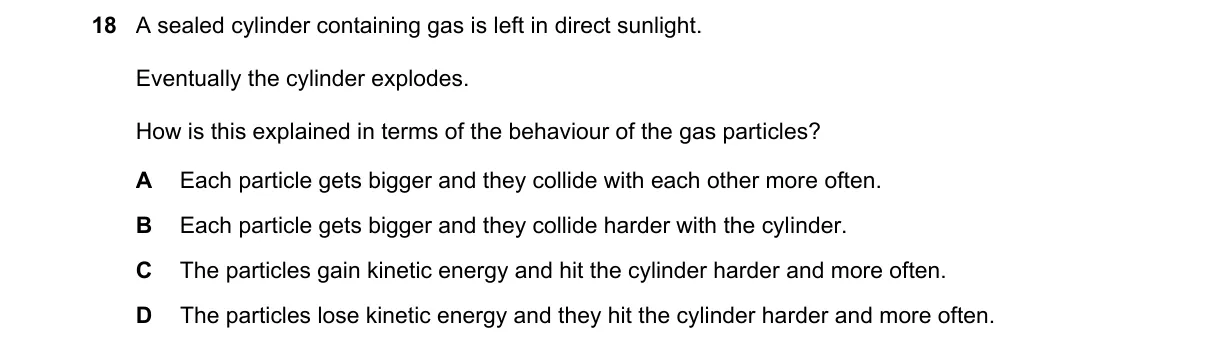
A sealed cylinder containing gas is left in direct sunlight. Eventually the cylinder explodes. How is this explained in terms of the behaviour of the gas particles?
Answer choices
- AEach particle gets bigger and they collide with each other more often.
- BEach particle gets bigger and they collide with the cylinder more often.
- CThe particles gain kinetic energy and hit the cylinder harder and more often.
- DThe particles lose kinetic energy and they hit the cylinder harder and more often.
Explanation
Gas Heating via Kinetic Theory
Steps:
- Sunlight warms the sealed cylinder, raising the gas temperature.
- Higher temperature increases the average kinetic energy of gas particles.
- Faster-moving particles collide with cylinder walls more frequently and with greater force.
- This raises internal pressure until the cylinder ruptures.
Why C is correct:
- Kinetic molecular theory states average kinetic energy is directly proportional to temperature (KE = 3/2 kT), so heating boosts speed, impact force, and collision rate.
Why the others are wrong:
- A: Gas particles are point masses with negligible, constant size; they don't expand.
- B: Particles don't grow larger; explosion stems from energy, not size change.
- D: Losing kinetic energy lowers temperature and pressure, preventing explosion.
Final answer: C
Topic: Particle model
Practice more O Levels/IGCSE Physics (5054) questions on mMCQ.me