O Levels/IGCSE Physics (5054)•5054/11/O/N/23
O Levels/IGCSE Physics (5054) — 5054/11/O/N/23, Question 21
An object of height 6.0 cm is placed in front of a converging lens of focal length 4.0 cm. The height of the image is The arrangement is shown on the scale diagram. What is the linear magnification produced by the lens?
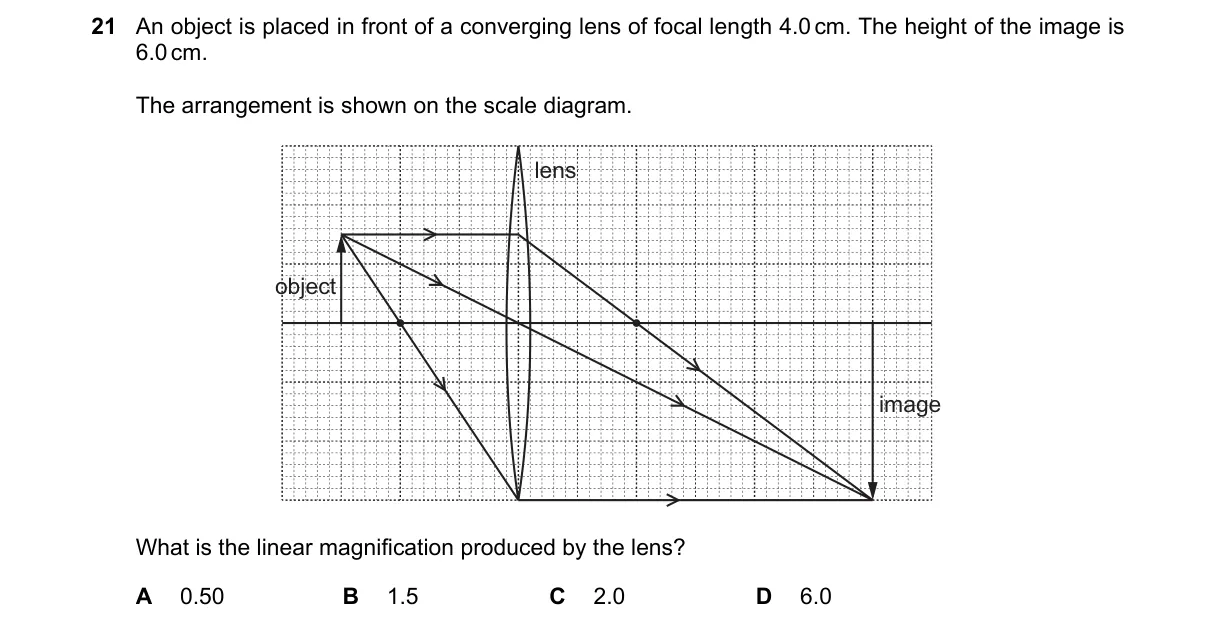
Answer choices
- A0.50
- B1.5
- C2.0
- D6.0
Explanation
Linear magnification from lens formula and image height ratio
Steps:
- Apply lens formula 1/f = 1/v - 1/u with f = +4.0 cm (converging lens); from diagram, measure u ≈ -6.0 cm.
- Solve for v: 1/v = 1/4 + 1/(-6) = 1/4 - 1/6 = (3-2)/12 = 1/12, so v = +12.0 cm.
- Calculate linear magnification m = -v/u = -12/(-6) = +2.0 (absolute value for size).
- Verify with heights: object h_o = 6.0 cm implies image height h_i = m × h_o = 12.0 cm, matching diagram scale.
Why C is correct:
- Magnification m = |h_i / h_o| = 12/6 = 2.0, per definition for transverse linear magnification.
Why the others are wrong:
- A: 0.50 implies minified image (object beyond 2f), but diagram shows enlarged real image.
- B: 1.5 mismatches calculated v/u ratio of exactly 2.0.
- D: 6.0 equals object height, ignoring lens effect; would require m=1 with h_i=6.0 cm.
Final answer: C
Topic: Thin lenses
Practice more O Levels/IGCSE Physics (5054) questions on mMCQ.me