O Levels/IGCSE Physics (5054)•5054/12/O/N/21
O Levels/IGCSE Physics (5054) — 5054/12/O/N/21, Question 33
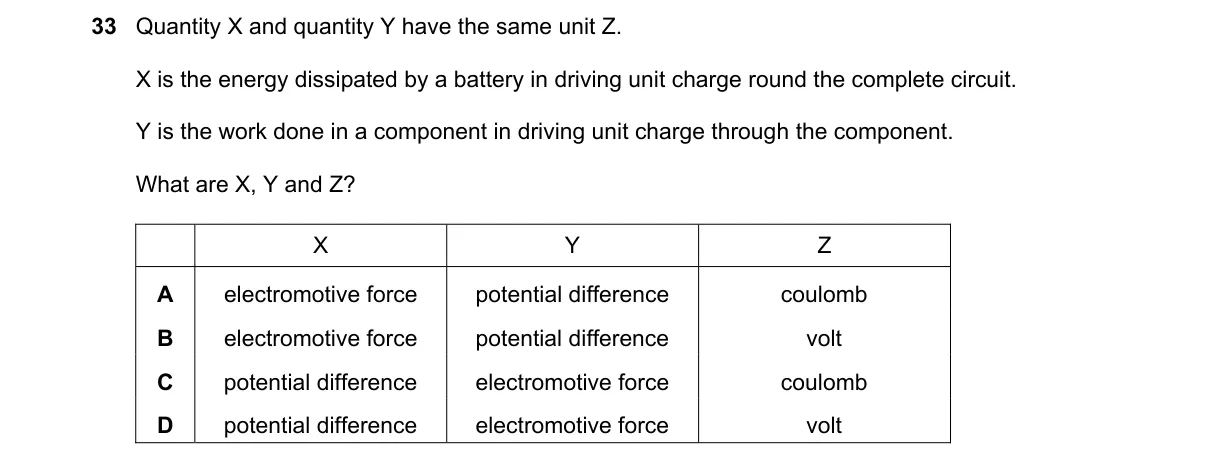
Quantity X and quantity Y have the unit Z. X is the energy dissipated by a battery in driving unit charge round the complete circuit. Y is the work done in a component in driving unit charge through the component. What are X, Y and Z
Answer choices
- Aelectromotive force, potential difference, coulomb
- Bpotential difference, electromotive force, coulomb
- Celectromotive force, potential difference, volt
- Dpotential difference, electromotive force, volt
Explanation
EMF and PD as work per unit charge Steps:
- X matches the definition of electromotive force (EMF): energy supplied by the battery per unit charge around the full circuit.
- Y matches potential difference (PD): energy lost (work done) per unit charge across a component.
- Both quantities equal work or energy per unit charge, so their SI unit is the volt (J/C).
- Choice C assigns X=EMF, Y=PD, Z=volt, fitting the descriptions and units.
Why C is correct:
- Definitions from circuit theory: EMF = total work by source per unit charge (Kirchhoff's voltage law); PD = work against field per unit charge in component; both measured in volts.
Why the others are wrong:
- A: Assigns correct X and Y but wrong unit (coulomb is charge, not energy/charge).
- B: Switches X and Y (PD ≠ full-circuit battery energy) and wrong unit (coulomb).
- D: Switches X and Y (EMF ≠ component work) despite correct unit.
Final answer: C
Topic: Electromotive force and potential difference
Practice more O Levels/IGCSE Physics (5054) questions on mMCQ.me